
Supply Chain Management
Approach and Policy
In accordance with the Mitsubishi Chemical Group Charter of Corporate Behavior, the Group gives due consideration to safety and the environment at every stage of its business, from product development and raw materials procurement, to production, sales, logistics and end-of-life disposal. We stand committed to CSR procurement (sustainable procurement) and building sustainable supply chains.
To achieve this, we believe it is essential to forge partnerships with our business partners based on mutual trust and to collaborate throughout all supply chains. Based on this approach, we have compiled standards on the environment, human rights, labor, and other areas in the form of our Request for Suppliers. We are now working to forge stronger relationships by sharing and explaining these standards with our business partners. We also ask our business partners for their cooperation in following up with their own upstream suppliers as necessary.
Going forward, we will continue to steadily advance our supply chain management initiatives to provide products and services that all customers can use with confidence, help build sustainable supply chains, and ultimately, realize a sustainable society.
Related Policies
Holding Briefing Sessions for Business Partners
The Mitsubishi Chemical Group holds briefing sessions for business partners to share its approach based on the Charter of Corporate Behavior. We share information on our individual measures related to each of the categories outlined in the MCG Group “Developing Cooperative Business Practices with Suppliers and Business Partners (Guidebook),” which summarizes a wide range of CSR-related standards in areas such as the environment, human rights, labor and anti-corruption.
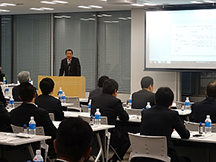
Briefing session for business partners
Mitsubishi Chemical Corporation Initiatives
Toward Promotion of CSR Procurement (Sustainable Procurement)
We believe it is very important to establish mutual trust-based partnerships and act on the entire supply chain. We also believe it is essential to have suppliers' cooperation on procurement activities. Such initiatives cannot be completed by our efforts alone. We think that delivering results requires enlisting the understanding and cooperation of our business partners and suppliers. We share our standards with direct business partners through our CSR Procurement Guideline and promote activities through initiatives arising from CSR surveys. We also ask our business partners to share and follow up on the standards mentioned above with their upstream suppliers. We will continue our efforts to engage in responsible CSR procurement throughout the supply chain.
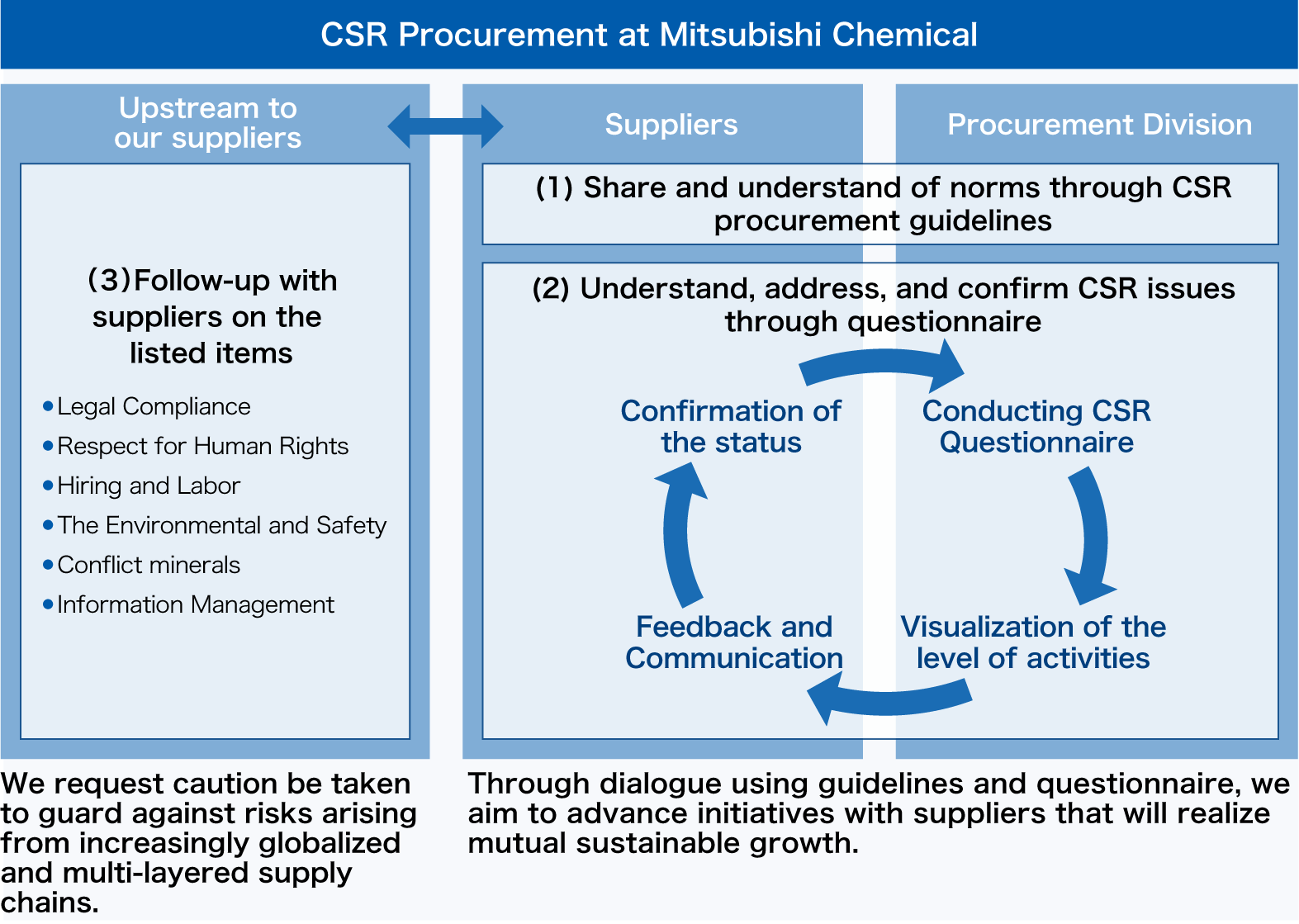
Human rights due diligence in the supply chain
MCC and its Group companies established the Human Rights Policy for Mitsubishi Chemical and its Group Companies in 2020 to guide initiatives related to respect for human rights in our business activities. We perform due diligence on human rights in our supply chain to fulfill our corporate responsibility of respect for human rights, based on this Human Rights Policy.
Management
Supply Chain will oversee human rights due diligence activities in the supply chain and extend these activities to Mitsubishi Chemical Corporation (MCC) and its group companies.
Human rights due diligence process in the supply chain
We are in the process of establishing a human rights due diligence process in line with what is detailed in the United Nations “Guiding Principles on Business and Human Rights.”
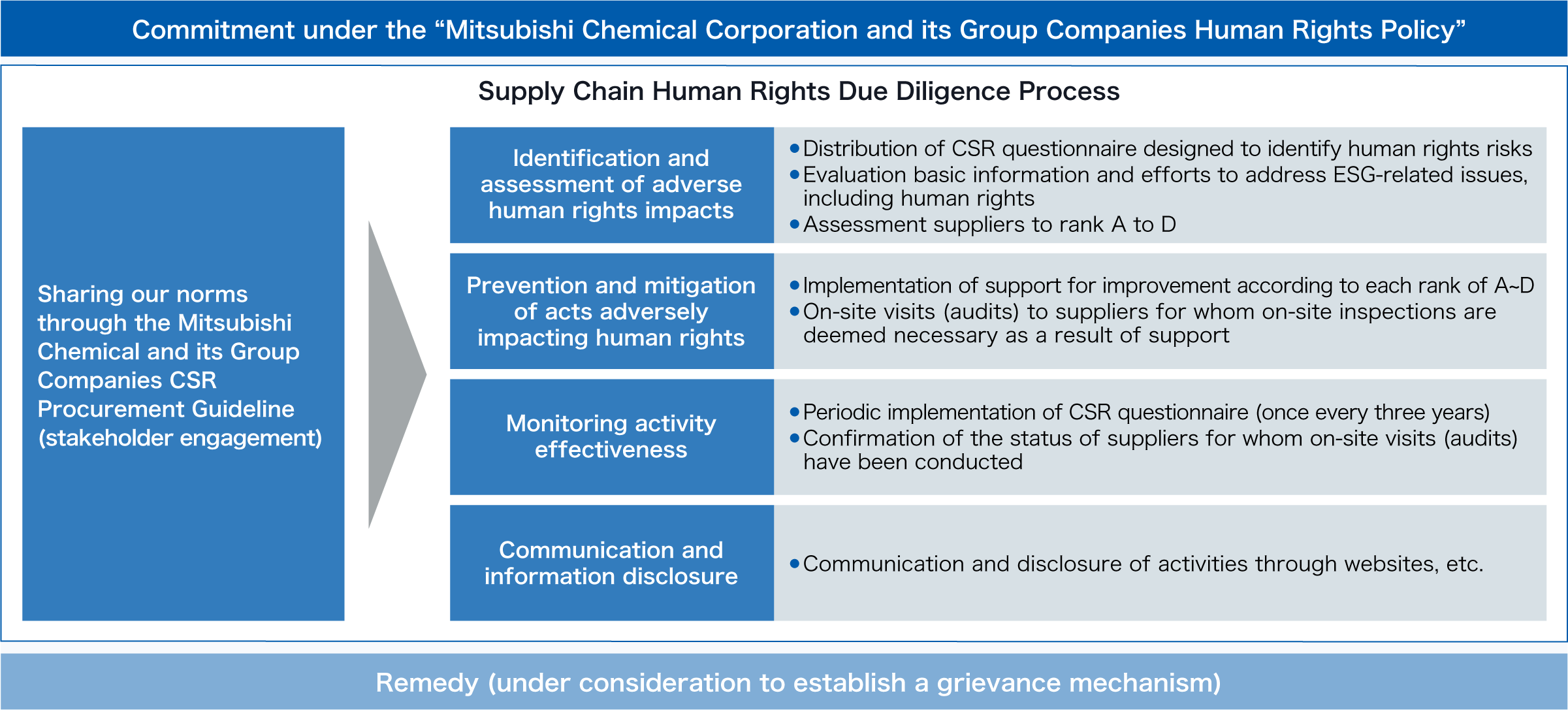
Sharing our norms through CSR procurement guideline (stakeholder engagement in the supply chain)
As a tool for promoting CSR procurement (sustainable procurement) based on our procurement policy, we have created the CSR Procurement Guideline (PDF: 483KB) , which summarizes the corporate activity approach of MCC and its group companies and our requests to our suppliers. We have summarized our standards in the Guidebook (PDF: 452KB) on things we want to share with our business partners and suppliers, which explains the standards in detail. The Guidebook can be downloaded from the link attached on the bottom of this page.
Identification and assessment of adverse human rights impacts
We confirm the status of initiatives with significant suppliers*1 and through the CSR questionnaire*2. We analyze and evaluate the results of CSR questionnaire responses (basic information and initiatives on ESG-related issues) and classify suppliers into four ranks: A, B, C, and D *3. We send a feedback letter to all suppliers who respond to the questionnaire. For new suppliers, we ask them to respond to the questionnaire before we start doing business with them.
- *1Significant suppliers are those suppliers whose efforts are deemed necessary to be verified in terms of ESG-related risks such as legal compliance, respect for human rights, employment, labor, environment, and safety, and also country-specific risk, industry-specific risk, and commodity-specific specific risks. At supplier screening, we also consider the relationship between the supplier and our business.
- *2MCC and its Group Companies CSR Questionnaire
| Category | Description |
|---|---|
| Basic Information | Company profile, location, industry, employee composition, certification status, etc. |
| Initiatives for ESG-related issues | Status of initiatives for each ESG-related issue listed in the Mitsubishi Chemical Group Charter of Corporate Behavior (consisting of 104 questions in total, covering legal compliance, respecting human rights, employment and labor, environment and safety, etc.) |
- *3Rank Classification
| Rank | Definition |
|---|---|
| A | Suppliers who have made sufficient efforts and are considered unlikely to commit acts adversely affecting human rights |
| B | Suppliers who have made certain efforts but need further continuous improvements |
| C | Suppliers who have made efforts, but are considered to have some concerns |
| D | Suppliers considered whose efforts are not enough and whose status we would like to check |
Prevention and mitigation of acts adversely impacting human rights
Based on the results of the CSR questionnaire, we hold CSR procurement Training sessions for suppliers in rank B,C and D to share our policy and request their cooperation in our activities. For suppliers in rank C and D, we confirm the details of their specific initiatives through individual interviews. If we find further investigation is necessary, we request on-site visits (audits) to suppliers.
In the on-site visit (audit), we provide feedback to suppliers on the results, including good points, and ask them to submit plans for improvement. We believe that these efforts will foster a healthy relationship between suppliers and MCC as business partners and help to build a relationship that enables mutual growth and improvement.
Monitoring activity effectiveness
For suppliers who have submitted corrective action plans in on-site visits (audits), we regularly track the status of these plans to ascertain the effectiveness of measures and encourage improvements. We also conduct a CSR questionnaire once every three years.
Communication and information disclosure
We will disclose the status of this initiative through the "Mitsubishi Chemical Corporation Sustainability Report" published annually and through this website.
Access to Remedy
We will continue to consider the establishment and introduction of an effective grievance mechanism to appropriately address acts that negatively impact human rights in our supply chain as it relates to our business activities.
Initiatives and Results
| Category | Fiscal 2021 Results | Fiscal 2022 Results | Fiscal 2023 Results | Fiscal 2024 Results | ||
|---|---|---|---|---|---|---|
| Percentage of purchases that was covered by the CSR questionnaire | 92% | 91% | 83% | 93% | ||
| Number of suppliers evaluated based on CSR questionnaire in the current fiscal year | 186 suppliers | 416 suppliers | 559 suppliers | 1,101 suppliers (FY21–24 total 2,262 suppliers) |
||
| Supplier education through CSR procurement training sessions (Target rank: B, C, D) |
Number of suppliers | 31 suppliers | 104 suppliers | 170 suppliers | 343 suppliers (FY21–24 total 648 suppliers) |
|
| Capacity building through Individual Interview (Target rank: C, D) |
Number of suppliers | 16 suppliers | 47 suppliers | 97 suppliers | 124 suppliers (FY21–24 total 284 suppliers) |
|
| Implementation rate | 100% | 100% | 100% | 94%(implementation ongoing) | ||
| Implementation of on-site visit (audit) for target suppliers*4 | Not applicable suppliers | Not applicable suppliers | 5 suppliers | 1 supplier | ||
| Implementation of human rights due diligence training for internal procurement departments. | Done | Done | Done | Done | ||
- *4Suppliers whose efforts were deemed insufficient through individual interviews
Responsible Mineral Procurement
In conflict and high-risk areas of the world, profits from mineral mining and trade are used to finance armed groups and rebel groups. The use of minerals from such areas can contribute to conflict, human rights abuses, and environmental destruction. We have formulated the "Mitsubishi Chemical Corporation and its Group Companies Responsible Mineral Procurement Policy" following our basic policy of not procuring minerals that are clearly involved in conflicts or human rights abuses in conflict zones or high-risk areas.
Training Programs for Employees
MCC believes that human resource development is important for the promotion of purchasing and procurement that takes into account CSR-related considerations. The Procurement Department holds the KAITEKI Promotion Conference for its employees twice a year to teach about and explain CSR.
We provide training on the tenets of the Basic Procurement Policy (namely, Fairness, Equitability and Transparency; Partnerships and Mutually Beneficial Relationships; Compliance with Laws and Regulations; and CSR Procurement) for new recruits or transferees assigned to the Procurement Department. In addition, we encourage junior employees to acquire Certified Procurement Professional (CPP)*5 certification as a way of improving individuals’ skills on an ongoing and systematic basis. As social concern regarding CSR procurement grows, we will continue to focus efforts on human resource development in this area.
- *5Certified Procurement Professional (CPP): A privately operated system of certification by the All Japan Federation of Management Organizations. The certification is granted to individuals involved in corporate purchasing and procurement who possess sufficient specialized knowledge in the field of purchasing and procurement.
Training programs run in fiscal 2024
| Category | Description | Percentage of targeted division personnel who completed training (%) | ||||
|---|---|---|---|---|---|---|
| Training for new recruits, transferred employees | Target: New recruits and newly transferred employees at the Head Office procurement division ・Basic training on the range of procurement policy (as needed) |
100% | ||||
| General meeting (KAITEKI Promotion Committee) | Target: Procurement Department employees ・Overview of compliance, information sharing on other CSR matters (twice a year) |
100% | ||||
Declaration of Partnership Building
MCC published a Declaration of Partnership Building in April 2021 and updated it in June 2025 in agreement with the objectives of the Council on Promoting Partnership Building for Cultivating the Future. This council comprises the Chairman of the Keidanren, Chairman of the Japan Chamber of Commerce and Industry and President of the Japanese Trade Union Confederation as well as related government ministers (from the Cabinet Office, Ministry of Economy, Trade and Industry, Ministry of Health, Labor and Welfare, Ministry of Agriculture, Forestry and Fisheries and Ministry of Land, Infrastructure, Transport and Tourism). By working with business partners in our supply chain and value-creating businesses to foster mutually beneficial relationships, we aim to build new partnerships.
Compliance with the Act Against Delay in Payment of Fees, etc. to Small and Medium-sized Entrusted Business Operators in Manufacturing and Other Specified Fields
To maintain sound relationships with its business partners, MCC has clarified a system for ensuring compliance with the Act and established internal rules, including Compliance Regulations, which indicate the specific scope of application and compliance requirements of the Act. To ensure that transactions are conducted pursuant to such internal rules, MCC periodically implements internal training and audits of related departments.
