
Natural Capital and Biodiversity
Approach and Policy
A strong commitment to sustainability management is essential for addressing climate change, water issues, realizing a recycling society, and biodiversity preservation. The chemical sector recognizes acknowledges its dependencies and impacts on nature throughout manufacturing processes and supply chains.
To achieve sustainable operations, the Mitsubishi Chemical Group identifies its own risks and opportunities related to natural capital, including climate change, water, soil, air, and biodiversity.
Governance
The Group has identified GHG emission reduction, reduced environmental impact, sustainable food and water supply, and biodiversity preservation as material issues.
- Material Issues and Sustainability (MOS) Indices
- Mitsubishi Chemical Group Biodiversity Preservation Policy

Initiative and Leadership
The Group endorsed the Declaration of Biodiversity by Keidanren*1 in 2010 and has since focused on reducing the impact of its business activities on biodiversity.
Additionally, Mitsubishi Chemical Corporation (MCC) and Nippon Sanso Holdings participate in the TNFD Forum*2. We monitor international discussions and engage with internal and external stakeholders regarding future actions.
- *1Declaration of Biodiversity by Keidanren: Announced by Keidanren (Japan Business Federation) in March 2009.
- *2The Taskforce on Nature-related Financial Disclosures. The TNFD aims to establish a framework for corporate risk management and disclosure regarding natural capital and other matters.
Strategy and Risk Management
Dependencies and Impacts on Nature
We used the ENCORE (Exploring Natural Capital Opportunities, Risks and Exposure) tool, as referenced in the guidance issued by the TNFD in 1–2, to identify the intersection between natural capital and our business value chain.
1) Recommendations of the Task Force on Nature-related Financial Disclosures (2023)
2) Additional sector guidance—Chemicals (2024)
The scope included MCC's main supply chain, covering upstream and downstream operations, as well as direct operations in basic chemical manufacturing and in the production of plastic and synthetic rubber materials.
The results showed that the refining and petroleum product manufacturing industry in the upstream supply chain is highly dependent on water purification. Regarding the impact on the natural environment, direct operations, both upstream and downstream, showed a high degree of impact from disturbances such as light and sound, as well as pollutant discharge into soil and water.
Based on these results, we prioritize identifying risks related to our direct operations. Many water-related risks were identified as medium to very high Water management is essential for stable operations, so, we focus on assessments and continue to improve management practices.
Factors affecting nature were found to be more significant than dependencies on ecosystem services.
Dependencies and Impacts on Nature by Business (5-point scale)
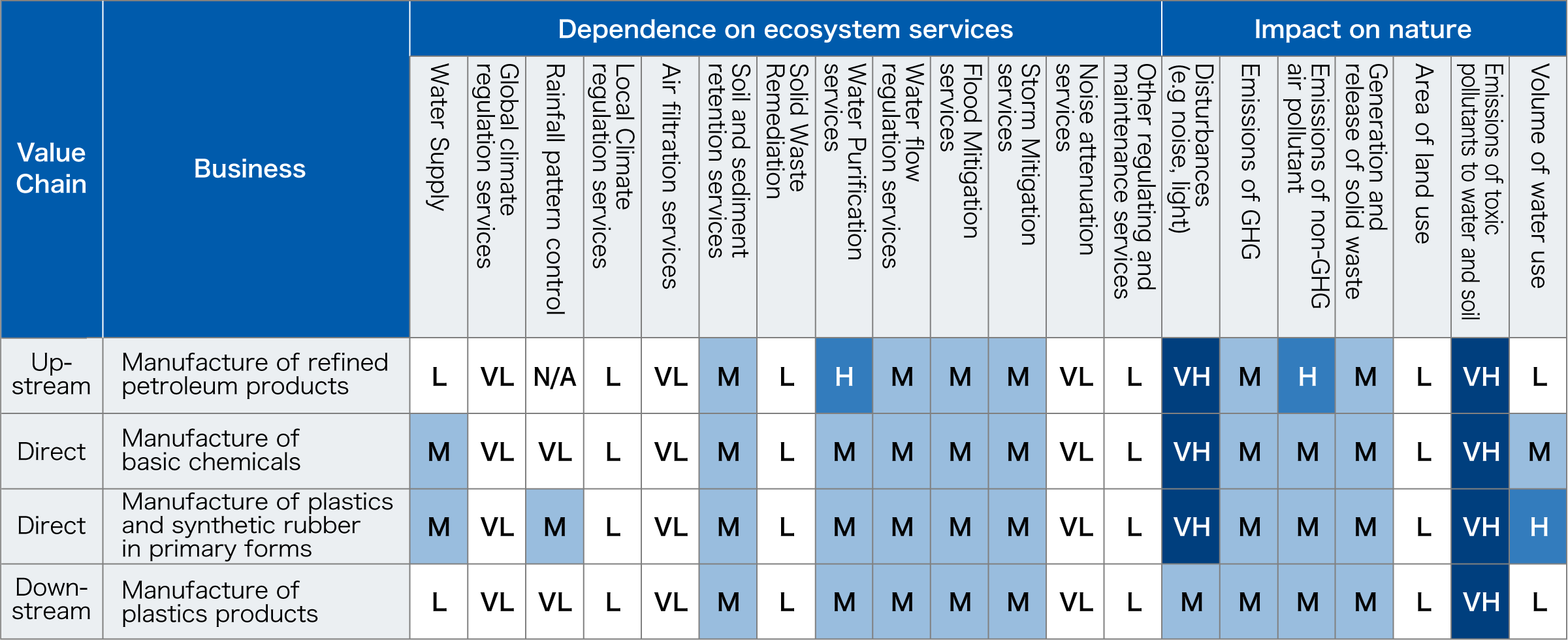
VH: Very high, H: High, M: Medium, L: Low, VL: Very low
Process of Identifying, Assessing and Managing Risk
Water Risk Analysis of Manufacturing sites
Because water management is vital for stable operations, we are prioritizing its assessment at our manufacturing sites. Based on the ENCORE results identifying many water-related risks, we conducted a water risk analysis for each site using the Aqueduct Water Risk Atlas*3.
This analysis covered sites accounting for 90% of water consumption at MCC's directly operated locations worldwide, including high-water-use sites.
Regarding the baseline water stress indicator (the ratio of total water demand to available renewable water resources [surface water and groundwater]), which measures sustainable water use, no sites were as high risk, scoring 3 or higher on the 5-point scale.
We will continue to assess our water-related risks and opportunities as part of our water management efforts.
*3A global water risk assessment tool developed and provided by the World Resources Institute (WRI).
Indicators and Targets
Current Initiatives and Future Outlook
To reduce the environmental impact of our business activities, we are advancing initiatives to prevent water and air pollution, reduce waste, conserve energy. We have also set quantitative sustainability targets for 2030 and will work steadily to achieve them.
Reducing GHG emissions
The Group has established a global target to reduce GHG emissions by 29% by fiscal 2030 compared to the fiscal 2019 baseline.
Reducing Waste
To use resources more efficiently, we will reduce landfill waste by 50% compared to fiscal 2023. This initiative applies only to Japan-based business sites.
Reducing the Risk of Discharging Water Pollutants
As part of our water resource management, we aim to reduce COD*4 emissions by 310 tons compared to fiscal 2023.
This initiative applies only to Japan-based business sites.
*4Chemical oxygen demand (a measure of the degree of water pollution caused by organic matter, etc.) is the amount of oxygen, expressed as a concentration, that corresponds to the amount of oxidant consumed when an oxidant is added and reacts (oxidizes) with organic matter in the water.
Management Policy
Initiatives at Business sites
We will continue to assess risks and opportunities related to natural capital to improve our sustainable performance in business operations. We will identify priority areas and expand our efforts to manage high-impact risks and opportunities across the entire supply chain.
