
Material Issues and Sustainability (MOS) Indices
The Mitsubishi Chemical Group has identified the material issues to be addressed by the Group . For the material issues it has identified, the Group has set targets and measures progress with the Management of Sustainability (MOS) Indices.
Identification Process of Material Issues
Step 1
| Selection of Material Issue Candidates | Taking into account the medium- to long-term direction of the Group, we have closely examined the material issues identified in the previous assessment*1 and added new ones that reflect the Group's philosophy, key policies, megatrends, SDGs, and so forth. |
|---|
Step 2
| Discussion on Classification and Structuring of Material Issues | The selected candidates for material issues were then discussed internally in light of the policies and actions of the medium-term management plan, to identify the final material issues. The Group classified material issues from the perspectives it considers important, such as business strategy, business foundations, and impact on the environment and society. |
|---|---|
| Assessment from Stakeholders’ Perspectives | The classified material issues were reviewed from a wide range of perspectives through interviews with external experts and discussions by the Director Liaison Committee*2. |
Step 3
| Setting of Targets and Indices | Targets were set for activities related to the material issues along with indicators to measure their progress (MOS Indices). |
|---|
Step 4
| Decision and Approval | The material issues were resolved by the Corporate Executive Officers Committee and the Board of Directors, along with the medium-term management plan |
|---|
- *1Assessments are conducted each time a medium-term management plan is formulated (approximately every five years).
- *2Formerly, the Outside Director Liaison Committee.
Overview of Material Issues
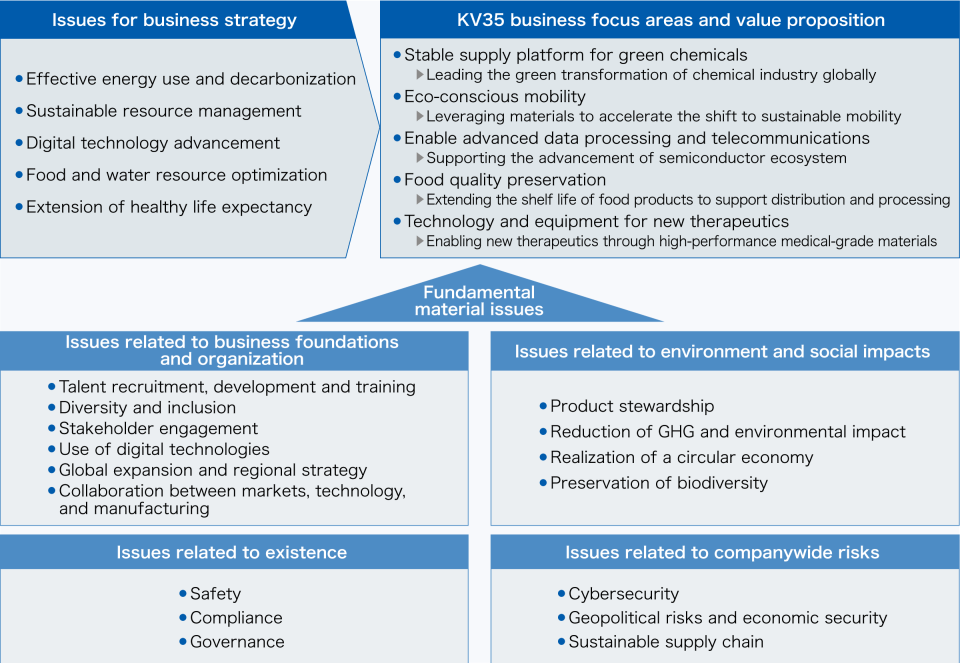
The MCG Group identifies material issues based on the double materiality concept.
For example, with regard to climate change, we have identified both "Reduction of GHG and environmental impact" which aims to mitigate our impact on climate change by reducing our GHG emissions, and "effective energy use and decarbonization," which aims to expand our businesses that help combat climate change, as material issues.
Material Issues and Sustainability (MOS) Indices
For the material issues identified by the Mitsubishi Chemical Group, targets are set and progress is measured with the Management of Sustainability (MOS) Indices. We will proceed steadily with initiatives on material issues by monitoring the yearly progress of each indicator.
Issues Related to Business Foundations and Organization
| Material Issues | Direction of Initiatives |
|---|---|
| Talent recruitment, development, and training | In order to adapt to uncertain environmental changes and accelerating technological innovation, we will encourage and provide opportunities for our human resources to continue self-improvement and personal growth. |
| Diversity and inclusion | We will increase diversity in our workforce based on gender, values, nationality, career background, age composition, and other characteristics, while also establishing inclusiveness and utilizing it in our corporate activities. |
| Stakeholder engagement | To be a company that is trusted by stakeholders, we will respect them, communicate closely with them, and work together with them to not only benefit corporate activities but to create a better society. |
| Use of digital technologies | By utilizing digital technology to reform all aspects of our business, including improving business processes such as research and development and manufacturing, and responding to customer and societal needs, we will not only optimize operations, but also develop new businesses and create services, continuously creating new value for companies, customers, and society. |
| Global expansion and regional strategy | Taking into account geopolitical changes, we will develop our business with strategies that are tailored to the trends and characteristics of each region. |
| Collaboration between markets, technology, and manufacturing | In order to resolve our customers' challenges more quickly, we will work to increase added value by thoroughly linking societal needs with optimal solutions. |
| MOS indices |
|---|
| Employee engagement |
| Diversity at the decision-making level |
| Evaluation related to the ESG stock index |
Issues Related to Environment and Social Impacts
| Material Issues | Direction of Initiatives |
|---|---|
| Product stewardship | To ensure that customers can use our products and services reliably and without concern, we will ensure quality and safety throughout their life cycle and work to minimize their environmental impact. |
| Reduction of GHG and environmental impact | We will work to reduce environmental impact caused by GHG emissions, water usage, and waste to help resolve climate change and water resource issues and create a recycling-oriented society. |
| Realization of a circular economy | Aiming for an optimized recycling-oriented society, we will work towards the smart use of resources, materials, and energy and create new value through innovation and business model transformation. |
| Preservation of biodiversity | We will understand the impact of our business activities on biodiversity and strive to minimize negative impact, while also working to contribute to the preservation of biodiversity through the advancement of environmental conservation activities and the provision of products and services. |
| MOS indices |
|---|
| Rate of reduction of GHG emissions |
| COD*3 reduction amount |
| Rate of reduction of landfill waste |
- *3Chemical Oxygen Demand (COD) | An indicator of the level of water pollution caused by organic matter, etc.(The amount of oxidizing agent consumed when oxidizing agent reacts (oxidizes) with organic matter in water is expressed as a value corresponding to the concentration of oxygen)
Issues Related to Companywide Risks
| Material Issues | Direction of Initiatives |
|---|---|
| Cybersecurity | In our corporate activities, we recognize the importance and responsibility of protecting information assets, and will strive to properly manage information and improve security awareness to prevent the leakage of confidential information of our customers, business partners, and our own company. |
| Geopolitical risks and economic security | We will investigate, collect information, and assess country risks in the countries and regions where we operate, upgrade action plans to respond to risks, and strengthen the establishment and operation of safety management systems and business continuity plans (BCPs) in preparation for contingencies. |
| Sustainable supply chains | We will build sustainable supply chains by deepening our business partners' understanding of the Group's management philosophy and working together to resolve environmental and social issues. |
| MOS indices |
|---|
| Number of serious information security incidents |
Issues Related to Existence
| Material Issues | Direction of Initiatives |
|---|---|
| Safety | Recognizing that health and safety represents the foundation for the very existence of the company and that we have a corporate social responsibility to assure health and safety, we will prevent accidents from occurring and continue to ensure safe business operations. |
| Compliance | Based on high ethical standards, we will comply with laws, international standards, and company regulations, and will always conduct our business activities in a fair, impartial, and honest manner. |
| Governance | We will strengthen corporate governance by improving management transparency and fairness, strengthening management oversight functions, and increasing management agility through faster decision-making. |
| MOS indices |
|---|
| Lost-time injury frequency rate |
| Number of serious Tier 1 accidents and Tier 1 accidents |
| Number of serious compliance violations and compliance violations related to the environment and safety |
| Number of serious compliance violations |
