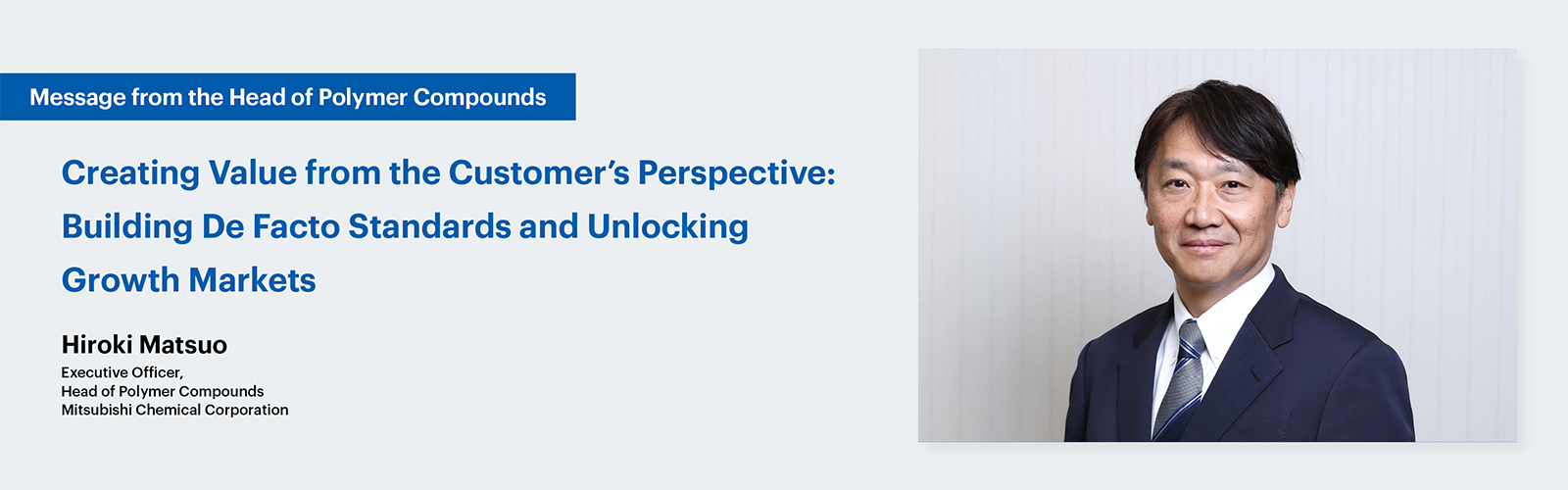
Message from the Head of Polymer Compounds

Creating Value from the Customer's Perspective: Building De Facto Standards and Unlocking Growth Markets
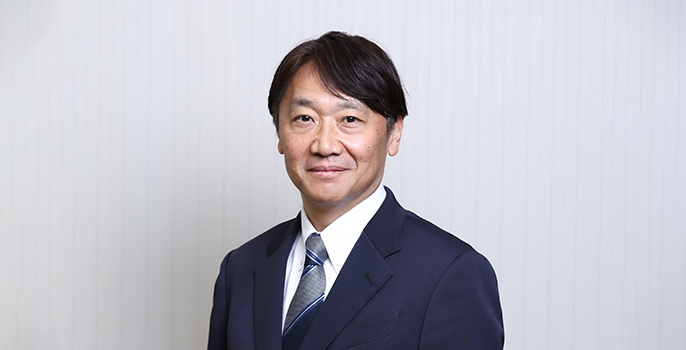
Hiroki MatsuoExecutive Officer,
Head of Polymer Compounds
Mitsubishi Chemical Corporation

Published in September 2026
*The information, positions, and affiliations mentioned in this special feature reflect the status at the time of the interview.

Published in September 2026
*The information, positions, and affiliations mentioned in this special feature reflect the status at the time of the interview.

It has been one year and nine months since the formulation of KAITEKI Vision 35 (KV35), the management vision outlining the Mitsubishi Chemical Group's aspirations for 2035, as well as Medium-Term Management Plan 2029.
During this period, the Mitsubishi Chemical Group has clearly defined its business portfolio and implemented a reorganization of its business groups in April 2026. As the Group shifts from a defensive stance to a more offensive, growth-oriented approach, the heads of each business group discuss how they view the changing business environment and how they aim to create value going forward.

The aims of integrating our compounds businesses

Our tailored compounds businesses originated from meeting customers’ need for functionalities that could not be achieved solely with general-purpose resins. However, the upstream materials segments of our compounds businesses, such as carbon fiber, polyolefins, and engineering plastics, have operated separately from one another. Meanwhile, an increasing number of global companies are managing compounds as a single business, allowing them to directly meet customer needs without being restricted to specific upstream materials. Against this backdrop and in conjunction with the formulation of KV35, in April 2026 we integrated our compounds businesses into a single business group upon comprehensive review. The aim is to create a structure that can deliver one-stop solutions for customer needs. I often use the analogy of “providing not only the suit, but also the jacket and shirt.” Going beyond the materials we handle, we will propose optimal solutions based on the voices of our customers while expanding our development pipeline.

The source of our competitive advantage and high profitability

It is not easy to explain the strengths of the Polymer Compounds Business Group. The equipment is not particularly unique and the raw materials we use can be purchased by anyone. You can gain a fairly good understanding of the materials we use by simply analyzing our products. By separately examining our technologies, such as formulation, compounding, quality assessment, molding, and application development, our products can be replicated by competitors. What truly matters, however, is the know-how for all of these elements: which raw materials to combine and how, the sequence in which they should be mixed, how quality should be assessed, and even how customers process and apply the materials. While each component may be replicated, combining all of them into a successful business is far more difficult.

The key is to identify the right combination quickly, work together with customers to create new markets, and establish these solutions as industry standards, or as we call them, “de facto standards.” Once a solution becomes a de facto standard, it is not easily replaced, enabling us to maintain high profitability over the long term. I believe the core strength of this business group is our wide range of de facto businesses, both large and small.

Take, for example, our material for automotive airbag covers. We worked closely with customers from the development stage to optimize design and molding processes, establishing them as an industry standard. As a result, more than 30 years after the business was launched, we continue to maintain a global market share of over 50%. Furthermore, this business does not require large-scale capital. By continuously accumulating expertise and know-how, we have developed the business from a relatively compact asset base. This is precisely why, once a de facto standard is established, it is difficult for competitors to enter the market, allowing us to maintain high profitability.

Growth strategy and commitment

Over the past few years, we have rigorously pursued price optimization, reviewed unprofitable businesses, and improved our cost structure. I believe this has significantly strengthened our earnings foundation. We are now entering an offensive phase focused on expanding our top line.

A key priority in this phase is capturing demand in growth markets. While our operations have centered on Japan, North America, and Europe until now, the widespread adoption of electric vehicles (EVs) has heightened the importance of markets such as China and India. We will leverage our established businesses to expand into new areas, while in India, we aim to further expand our business with automotive manufacturers.

We also view market changes as an opportunity. The rise of EVs is transforming the performance requirements for materials, while emerging markets such as health care and data centers continue to expand. We intend to identify new needs arising from these changes and translate them into business opportunities.

Supporting these efforts is our regional operating structure consisting of Japan, China, the Asia-Pacific, Europe, and the Americas. Customer needs are best understood at the local level. To respond swiftly to locally identified needs, we are delegating greater decision-making authority to each region to facilitate timelier decision-making.

We also plan to actively leverage digital technologies even further. By enhancing our digital marketing and pipeline management capabilities, we will effectively identify customer needs and market trends, creating new opportunities for business growth.

New opportunities will arise wherever markets are changing. By quickly identifying these changes and steadily building a portfolio of de facto standards, both large and small, we aim to achieve sustainable growth while maintaining high profitability.

【Profile】
Joined Mitsubishi Yuka Corporation (now Mitsubishi Chemical Corporation) in 1993. He was engaged in the Performance Polymers Business, focusing mainly on functional polymers and thermoplastic elastomers (TPEs) as an account manager.
In 2007, he was assigned to Mitsubishi Chemical Performance Polymers, Inc. in the United States. In 2014, he became managing director of Advanced Plastics Compounds Singapore Pte. Ltd., where he gained extensive experience in global business management.
He subsequently served as general manager of the Global Business Office of the Performance Polymers Division in 2018, general manager of the Performance Polymers Sector in 2021, head of the Japan Division of the Specialty Materials Business Group in 2023, and head of the Business Strategy Division of the Advanced Films & Polymers Business Group in 2024.
In December 2025, he began leading the integration of the compounds businesses as director of the Compound Business Integration Project Office. Since April 2026, he has served in his current position as executive officer and head of the Polymer Compounds Business Group.

Back to top