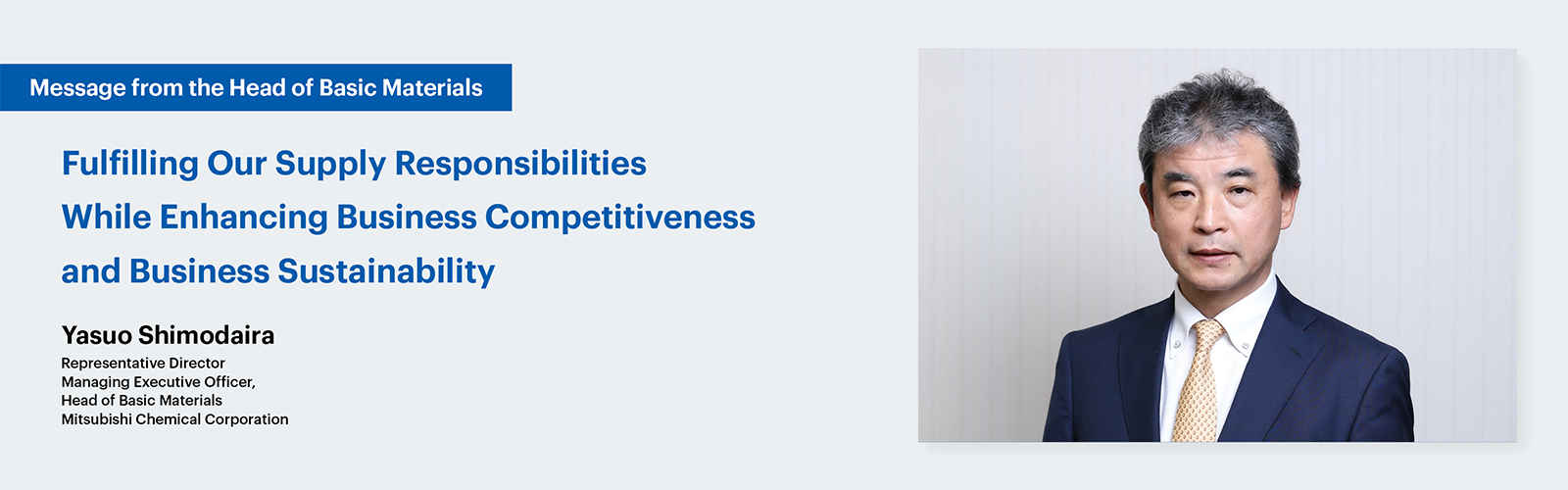
Message from the Head of Basic Materials

Fulfilling Our Supply Responsibilities While Enhancing Business Competitiveness and Business Sustainability
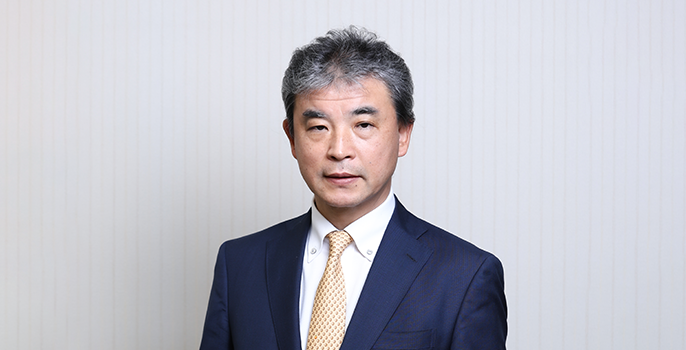
Yasuo ShimodairaRepresentative Director,
Managing Executive Officer,
Head of Basic Materials
Mitsubishi Chemical Corporation

Published in September 2026
*The information, positions, and affiliations mentioned in this special feature reflect the status at the time of the interview.

Published in September 2026
*The information, positions, and affiliations mentioned in this special feature reflect the status at the time of the interview.

It has been one year and nine months since the formulation of KAITEKI Vision 35 (KV35), the management vision outlining the Mitsubishi Chemical Group's aspirations for 2035, as well as Medium-Term Management Plan 2029.
During this period, the Mitsubishi Chemical Group has clearly defined its business portfolio and implemented a reorganization of its business groups in April 2026. As the Group shifts from a defensive stance to a more offensive, growth-oriented approach, the heads of each business group discuss how they view the changing business environment and how they aim to create value going forward.

The closure of the Strait of Hormuz highlighted uncertainty in raw material procurement

The Basic Materials Business Group is facing various headwinds, including fluctuations in resource and energy prices, rising geopolitical risks, and a gradual decline in domestic demand. In particular, the closure risk of the Strait of Hormuz is a critical management issue that directly affects the procurement and stable supply of naphtha and other raw materials. Therefore, we are working to secure alternative procurement sources and gain customers’ understanding of the sudden increase in raw materials costs.

On the other hand, the crisis has allowed us to reaffirm the value of petrochemical products and the importance of the petrochemical industry from the perspective of economic security. Against this backdrop, we recognize that our greatest challenge is balancing profitability and sustainability while fulfilling our social responsibility of ensuring a stable supply of basic chemicals.*

* Raw materials for plastics and other chemical products derived from the thermal cracking of naphtha

The expected structural reform of the petrochemical industry

We have already made important decisions on significant structural reforms, such as the integration of ethylene production facilities in western Japan and withdrawing from the coke and carbon materials business. These decisions were not based on short-term earnings, but rather on the perspective of how our business group activities can continue to be valued by society over the medium to long term. As the executive responsible for this business group, I have focused particularly on considering the best outcomes for not only the Group but the industry as a whole, reallocating management resources to growth opportunities and pursuing a realistic business scale that fulfills our supply responsibilities. These structural reforms are intended to clarify what must be preserved going forward. Our decision to exit the coke and carbon materials business was a difficult one, made in light of irreversible changes in the business environment.

Commencement of discussions for the spin-off of the petrochemicals business

Our petrochemicals business is an important part of the social infrastructure that supports the Japanese economy and daily life. Amid intensifying global competition, ensuring a stable supply of materials to Japan’s wide range of industries is imperative, as they have a direct influence on economic security. In the petrochemicals business, advancing the use of renewable resources—such as plants and agricultural products and byproducts—and waste—as feedstock for chemical products that serve as alternatives to conventional fossil fuel-based chemicals—is important for Japan's efforts toward carbon neutrality. Fulfilling these social responsibilities entails industry restructuring, including collaboration with other companies. By spinning off the petrochemicals business into a separate, wholly owned subsidiary, we will develop a framework that can respond swiftly to structural reforms aimed at strengthening our business foundation, including the establishment of joint ventures with strategic partners.

Business strategies for fiscal 2026, including resource circulation initiatives

The instability of our business operations impacted our performance in fiscal 2025, and we take this matter very seriously. Accordingly, in fiscal 2026, our highest priority is to ensure safe and stable operations while maintaining high operating rates and to focus on rebuilding a cost-competitive supply platform for basic chemicals. Strengthening on-site capabilities, including facilities, personnel, and operational data, will be critical to ensuring the long-term viability of our business group. With respect to our circulation initiatives, we will steadily advance the commercial operation of our chemical recycling plant at the Ibaraki site, which converts waste plastics into oil. Together with product marketing efforts aimed at creating added value, we will accumulate operational results at a realistic pace. As a supplier of basic materials, we play a key role in supporting transformation across the entire value chain. We will continue to evolve into a business group that meets the needs of society and industry.

Commitment to realizing KV35

I believe the mission of the Basic Materials Business Group is to sustainably pass on businesses that underpin the foundations of society to future generations. I am committed to achieving KAITEKI in particular by rebuilding our competitiveness starting from the front lines and transforming the business group into one that our employees can take pride in. To achieve this, we must reshape the market structure into one that generates stable profits and ensure that customers appropriately recognize the value we provide. As we advance structural reforms, it is essential that we shift from a defensive to a more proactive approach and foster an organizational culture that embraces change and encourages employees to take on new challenges. I will take the lead in ensuring that the Basic Materials Business Group remains an indispensable foundation for achieving KAITEKI.

【Profile】
Joined Mitsubishi Kasei Corporation (now Mitsubishi Chemical Corporation) in 1990 and began his career in the terephthalic acid business. In 2003, he was appointed vice representative of Mitsubishi Chemical Corporation’s Beijing Office.
He subsequently was responsible for business operations in China and other parts of Asia, including as deputy general manager of Ningbo Mitsubishi Chemical Corporation, director of MCC PTA Asia Pacific Pte. Ltd., and general manager of Ningbo Mitsubishi Chemical Corporation.
After serving as general manager of the Terephthalic Acid Department within the Chemicals Division from 2013, general manager of Ningbo Mitsubishi Chemical Corporation from 2015, and head of the Planning Office, Petrochemicals Planning Department from 2017, he was appointed general manager of the Semiconductor Solution Department in 2019 and has since been in charge of semiconductor-related businesses.
In April 2024, he was appointed representative corporate executive officer and executive vice president of Mitsubishi Chemical Group Corporation, overseeing the Basic Materials & Polymers segment. In April 2025, he became representative director of the Board and managing executive officer of Mitsubishi Chemical Corporation while remaining in his position as head of the Basic Materials & Polymers segment (later renamed as the Basic Materials segment). He assumed his current position in April 2026.

Back to top