
Changing the “Norm” for EV Battery Enclosures:
Mitsubishi Chemical Takes Up The Challenge.
03/18/26
/ Article on Business Insider Japan
*This English text is a translation of a document originally prepared in Japanese.
*The information, positions and affiliations mentioned in this interview reflect the status at the time of the interview.
*“Mitsubishi Chemical” refers to Mitsubishi Chemical Corporation, while “The Mitsubishi Chemical Group”
refers to Mitsubishi Chemical Group Corporation and its group companies.
Expansion of the EV (electric vehicle) market has seen a growing demand for the simultaneous achievement of vehicle weight reduction, greater safety and reduced environmental impact. The key lies in battery-related materials technology. GMTeFR™, developed by the Mitsubishi Chemical Group for use in EV battery enclosures, is also one of the materials designed to address challenges facing the automotive industry. This is an innovative material that combines flame retardancy with a lightweight, readily moldable inorganic fiber-reinforced thermoplastic composite*1, designed with consideration for recyclability.
How will this new composite GMTeFR™ material contribute to the evolution of the EV battery? We explore this topic from the perspectives of Daisuke Onodera of the Iide Battery Lab Co., Ltd. who has acquired a deep understanding of the technological trends among global automakers through EV reverse engineering*2, and Nobuaki Takata of Mitsubishi Chemical who leads new business development for material solutions of battery-related components.
*1A plastic-based composite reinforced with inorganic fibers, such as ceramic fibers, that can be formed by heating.
*2A method of investigating manufacturing methods and operating principles through disassembling machinery and analyzing its operation.
The last line of defense against thermal runaway
HEVs (hybrid electric vehicles) and PHEVs (plug-in hybrid electric vehicles) account for a significant share of new car sales, while BEVs (battery electric vehicles) are also increasing in popularity. These vehicles are broadly categorized as EVs and have the common feature of being equipped with large batteries.
“Lithium-ion batteries are essentially safe when handled properly and the risk of them catching fire is low. Despite this, providing against thermal runaway caused by loss of control or physical damage is a high priority for auto manufacturers,” says Nobuaki Takata of Mitsubishi Chemical.

Nobuaki Takata: Senior Director, Thermoplastic Composite Department, Composite Materials Division, Mitsubishi Chemical Corporation.
After managing market development for engineering plastics for a wide range of industries (including aerospace, mobility, food, LCDs and semiconductors, information and electronics, logistics and healthcare), he embarked on new business development for battery-related components. He leads the planning and development of new business initiatives. He assumed his current position in April 2025.
“If a single cell (the smallest unit capable of storing energy) goes into thermal runaway, that heat can spread to adjacent cells and potentially trigger a chain reaction of explosions. One of the major roles of a battery enclosure is to suppress the flame or gas that arises from such thermal runaway.” (Takata)
While vehicles are becoming increasingly lighter, and metal internal and external components are being replaced with plastic, materials for battery enclosures in the EV market are still mainly metals such as aluminum or steel, with only a very small portion being plastic.
There has long been a need, however, to utilize plastics for the purpose of weight reduction.
Recyclability will also become an important factor in expanding the future adoption of plastics. Behind this trend is the existence of accelerating environmental regulations, mainly in Europe, particularly the “ELV (End-of-Life Vehicles) Regulation.” Under these regulations, which are based on the concept of resource circulation, including re-use, manufacturers must ensure that at least 15% of the plastic parts used in vehicles are made from recycled materials within six years of the regulations taking effect, and 25% must be recycled materials within 10 years. Furthermore, 20% of these recycled materials must be derived from end-of-life vehicles (ELVs).
“We have also been developing recycling technologies with a view to complying with environmental regulations. However, under our Group’s Purpose, KAITEKI—the well-being of people and the planet—and with the realization of a sustainable society in mind, it was inevitable that we pursue plastic materials capable of mechanical recycling*3 so that they can be utilized again in automotive components even after their initial lifecycle.” (Takata)
*3Recycling materials that are physically crushed, melted and molded to use them as new plastic raw materials or products.
Typically, the plastics used in some battery enclosures were mainly “thermosetting plastics” that do not melt once cured, making them unsuitable for mechanical recycling. In contrast, “thermoplastics” feature the ability to melt when heated, allowing them to be remolded and recycled.
However, battery enclosures need to be flame retardant to prevent thermal runaway. The challenge was how to suppress high-temperature flames caused by a battery fire when using thermoplastics. The solution to this problem is GMTeFR™ (fiber‑reinforced thermoplastic composite – flame‑retardant grade), a product developed using a proprietary material combining inorganic fibers impregnated with a thermoplastics matrix, and flame-retardant plastics technology.
A shared vision formed through site visits
Mitsubishi Chemical enlisted the cooperation of the Iide Battery Lab, based in the town of Iide in Yamagata Prefecture, for the development of materials for EV battery enclosures. The Institute leverages its expertise in battery reverse engineering to undertake battery design and development tailored to device characteristics.
As a company that has purchased EVs from around the world from the early days of electric vehicles, then disassembled and analyzed them right down to battery cell level, they are truly unique in Japan.
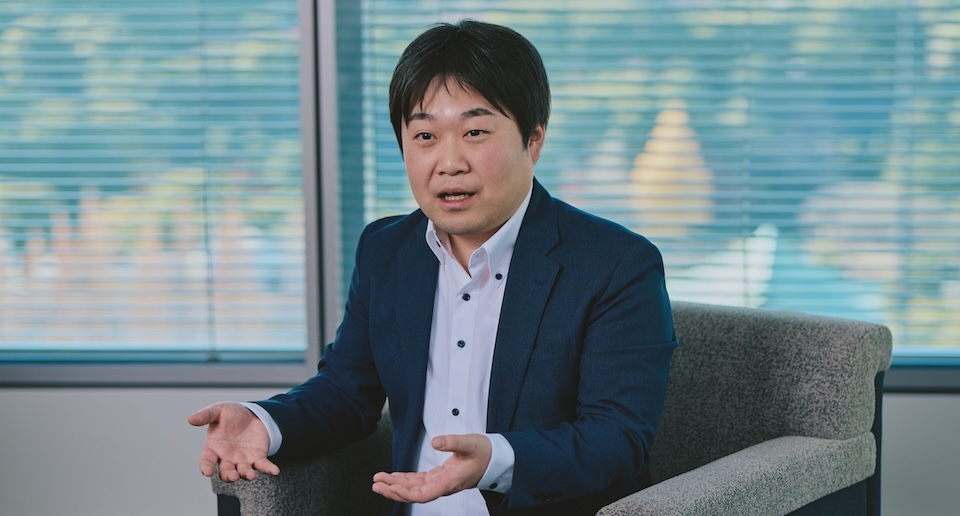
Daisuke Onodera: Representative, Iide Battery Lab Co., Ltd.
Also serves as a lecturer at the Professional University of Electric Mobility Systems and as a visiting Associate Professor at Shizuoka University. In 2016 he founded the Iide Battery Lab. The Institute provides R&D support in the battery field, conducts benchmarking of the latest lithium-ion batteries, and undertakes independent analyses mainly on batteries used in overseas EVs.
“Our strength lies in the fact that we are not dependent on Internet information or catalog specifications but that we actually buy EVs and thoroughly test the real vehicle. A look at the results reveals the incredible speed of product development by Chinese manufacturers. They test every conceivable combination of materials and methods, working through trial and error and immediately adopt the best. The only way to grasp the pace and reality of the situation is to look at the actual product.” (Onodera)
Disassembling battery cells is dangerous work. Contact between the positive and negative terminals causes a short circuit resulting in sparking and explosive fire. The electrolyte is also hazardous, making proper handling essential. The person needs to be well-versed in both mechanics and chemistry. It is for this very reason that Mitsubishi Chemical is also collaborating with the Iide Battery Lab to further deepen the expertise it already possessed in relation to batteries.
“Our hands-on researchers from across different departments—including not only plastics specialists but also battery material experts— make regular visits to the Iide Battery Lab. The Mitsubishi Chemical Group has established “Connect” as a keyword to achieve its ‘KAITEKI Vision 35” management vision, and this is indeed an initiative that embodies this word.” (Takata)
Takata spoke further about the aims of the collaborative work with the Iide Battery Lab.
“In order to address customer needs, the person in charge of plastics and the person in charge of battery materials should not specialize only in those areas. It is important for them to seamlessly collaborate across the organization and consider what is best for the battery system as a whole.” (Takata)
Onodera also agrees with that approach. “Numerous companies come for site visits but it’s possibly only Mitsubishi Chemical that brings multiple people across different departments. I believe that their efforts to create a common understanding as a team will lead to faster development, and I feel a strong sense of unity among them.”
“During their visits to our company, the engineers from different departments of Mitsubishi Chemical hold discussions while gathered around a disassembled battery. Having people from diverse departments have discussions while looking at the actual product enables development based on reality rather than just theory. It is precisely this free exchange of opinions on the front lines of development, and the new insights gained from it, that are so valuable.” (Onodera)
The fusion of opposites: how can a material melt yet resist fire?
The aforementioned GMTeFR™ was developed in cooperation with the Iide Battery Lab, based on a deep understanding of the latest trends and challenges in battery technology.
Its most distinctive feature is that, while it is a “thermoplastic” capable of melting, it also possesses “flame retardant” properties that stop flames. In actual combustion tests, even when continuously directly exposed to a burner flame to simulate battery thermal runaway, there was no sign of any holes forming in the material.
“GMTeFR™ was developed by applying Mitsubishi Chemical’s flame-retardant technology to fiber-reinforced thermoplastic composites manufactured by Mitsubishi Chemical Advanced Materials. Suppressing flames using thermoplastics is an extremely challenging technological undertaking.
The key to this development lay in bringing together our Group’s technologies and expertise in fibers, plastics, and battery systems, and carefully optimizing the composition of fibers and plastics based on a thermoplastic matrix. By leveraging the interaction between fire-resistant specialty fibers and plastics, we successfully achieved a balance between strength and rigidity, lightweight design, formability, and design with consideration for recyclability.” (Takata)
What are the points of superiority of GMTeFR™ compared to the current mainstream aluminum battery enclosures? Takata explains, “Apart from the obvious general advantages of thermoplastics, including weight reduction, component integration and recyclability, from a battery perspective there is also the advantage of minimizing temperature variations.” Lithium-ion batteries are comparatively sensitive to temperature fluctuations. Degradation progresses whether the temperature is low or too high and also progresses if there are temperature variations within a cell. It is vital to maintain a uniform temperature environment for all cells.
“Because of their high conductivity, aluminum and steel are directly impacted by external temperatures. Similar to the area around an aluminum-framed window which feels cold in winter, the battery enclosure is also prone to cooling in the outside air, creating temperature variations inside the battery. If these conditions persist, the internal electrodes deteriorate, and in the worst case, it could trigger thermal runaway. We believe that if we can implement an appropriate heat management system leveraging the insulating properties of plastics, we can keep the battery at a constant temperature which will not only ultimately extend battery life and improve safety but also contribute to enhancing fast charging performance.” (Takata)
Onodera agrees with this view.
“China is leading the global EV market and looking at the latest trends there, extending battery life is a major focus. Stringent temperature control is essential for making batteries that last 10 or 20 years. In that sense, a plastic enclosure with outstanding thermal insulation properties is a very logical choice.” (Onodera)
Dominating the global market through recyclability
While applying flame-retardant properties to thermoplastics was a technically challenging development, Mitsubishi Chemical was also pursuing not only safety but recyclability.
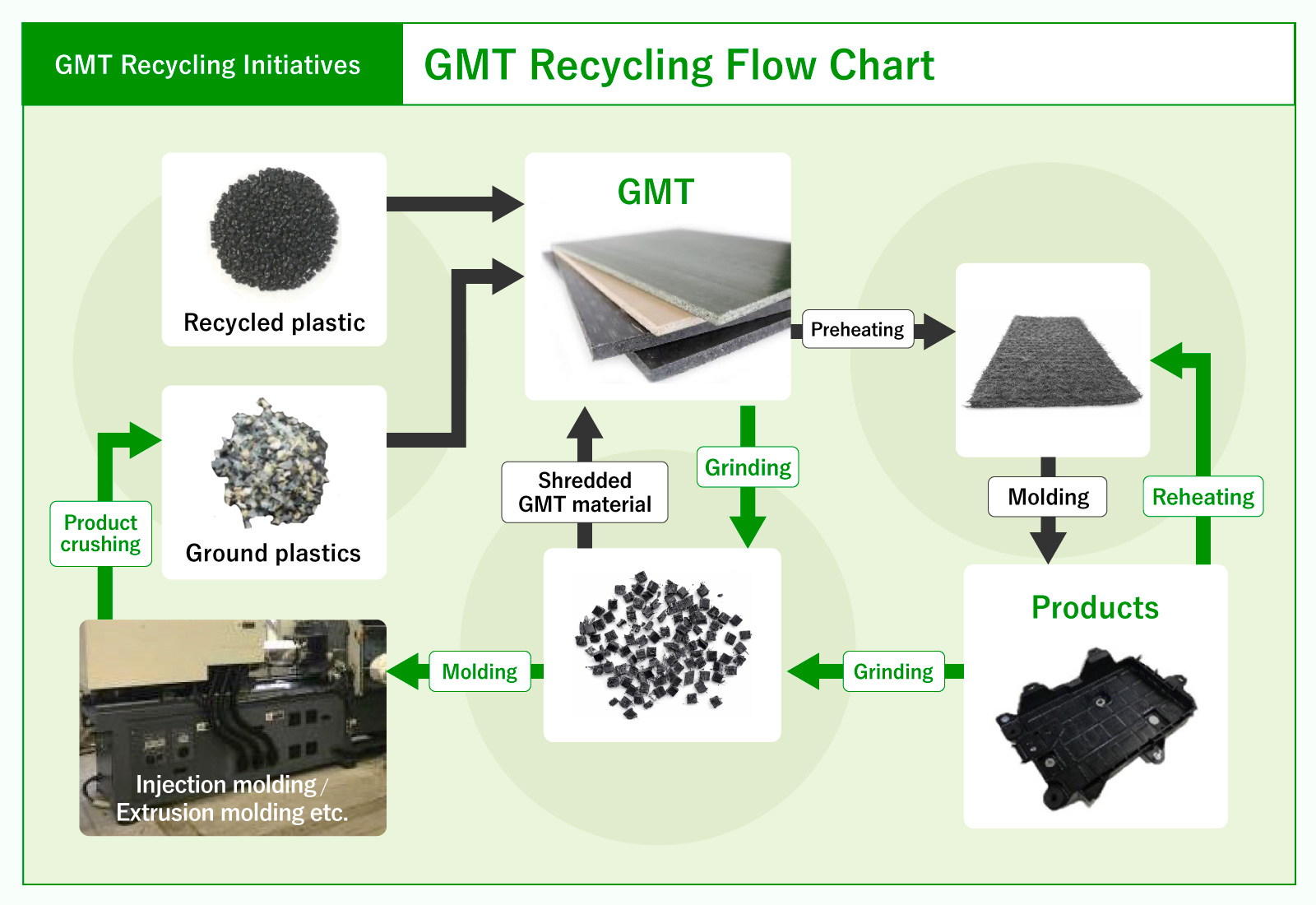
“Typically, mechanical recycling of plastics requires more than five steps—crushing, sorting, melting, pelletizing, and so on. In contrast, GMTeFR™ is formed from a method called press molding. At Mitsubishi Chemical Group we have carried out several lab trials to develop a press molding technology to enable recycling of the battery enclosures. Technically, used enclosures are simply cut into a size that fits into a heating oven, then heated and pressed. This enables closed-loop recycling as battery enclosures while maintaining a high level of their initial performance. While injection molding is the primary method of plastic molding, when considering recycling large plastic components required for EVs, we believe that press molding also becomes an option.” (Takata)
Onodera also perceives advantages in recycling.
“For example, when we look at the battery pack design philosophy in China where EV development is advanced, the design still does not fully take account of recycling. If Mitsubishi Chemical can come up with a package for the design and materials of a battery pack that are easily recycled, have a long life, and are safe, we should be able to compete well in the global market.” (Onodera)
The future envisaged by Mitsubishi Chemical is not a simple material replacement from metal to plastic. Takata explains from the perspective of contributing to the overall life-cycle.
In my view, the essential prerequisite for a circular society is practicality. No matter how environmentally advanced a recycling technology may be, it won’t be adopted if it is economically unsustainable. This is why we prioritize not only environmental ideals but also economic sustainability. The ultimate goal of GMTeFR™ is to establish a recycling system that is economically viable. By leveraging the strengths of GMTeFR™—lightweight properties, safety, and recyclability—we aim to deliver value beyond that of traditional metal materials like steel and aluminum. As a trusted partner for our customers, we intend to become an indispensable presence in the EV market.” (Takata)
In conclusion, Onodera expressed his hopes for Mitsubishi Chemical, saying, “I hope that you will continue to maintain the practice of looking at the actual products, touching them and verifying them for yourselves. Mitsubishi Chemical is developing a diverse range of materials. If you continue to leverage lessons learned from past experience, and demonstrate core technical expertise, you will be able to create new value and identify key factors for winning in a global market.”
Click here for Mitsubishi Chemical’s Automotive solutions.
Automotive solutions
Click here for the GMTeFR™ (Fiber‑reinforced thermoplastic composite –flame‑retardant grade) product page.
GMTeFR™ (Fiber‑reinforced thermoplastic composite –flame‑retardant grade)
- Share


