
Polypropylene’s Circulation Story
New Possibilities Opened by NOVAORBIS™
04/16/26
/ TEXT BY MCG
*The information, positions and affiliations mentioned in this interview reflect the status at the time of the interview.
The automotive industry is undergoing a major transformation. In Europe, a provisional agreement was reached in December 2025 on End-of-Life Vehicle (ELV) regulations covering the disposal and recycling of used vehicles. Globally, there is strong demand for greater use of recycled materials. Among them, the recycling of polypropylene (PP) is a crucial piece, accounting for approximately 35-45% of the plastics used in automobiles. We asked team members involved in PP circulation about three aspects of paving the way to a recycling-oriented society: the market, systems, and LCA.
-
From left:
Nobuhito AratakeSustainability & Government Affairs Division,
Sustainability & Solutions Department
Mitsubishi Chemical Corporation
Kazuo AsukaCorporate Planning Department, Corporate Planning Group
Japan Polypropylene Corporation
Sakurako KomiyaStrategy & Planning Division, CN & CE Strategy Department
Basic Materials & Polymers Business Group
Mitsubishi Chemical Corporation
Full-scale Vehicle Recycling Gets Underway
Asuka: One aspect of Europe’s ELV regulations we are closely watching is the required rate of recycled plastic utilization. They mandate the phased introduction of recycled materials into plastics used in new vehicles, with targets of 15% after six years from enforcement and 25% after 10 years. For the time being, mechanical recycling (a process that returns an object to its raw materials through physical means such as crushing and melting) will be the main focus, but we will need to continue close monitoring of deliberations in the European Parliament on how they plan to handle chemical recycling (a chemical process that breaks down waste plastic to turn it back into chemical feedstock such as oil and monomers) and bio-based materials.

Kazuo Asuka/Corporate Planning Department, Corporate Planning Group, Japan Polypropylene Corporation
In response to developments in Europe, Japan is also accelerating its approach to plastic recycling. Japanese automakers export many vehicles to Europe, so they will inevitably have to comply with the ELV regulations. The Japan Automobile Manufacturers Association has also set a longer-term target of 15% utilization by 2035, while the Japanese government has launched an industry-government-academia consortium led by the Ministry of the Environment. Japan Polypropylene, together with Mitsubishi Chemical, has joined this consortium as observers to keep up with the latest developments.
Among plastic recycling initiatives, polypropylene (PP), which we handle, is one material drawing particular attention. PP is the most commonly used plastic in automobiles. You find it in bumpers, instrument panels, door trims, and elsewhere. PP accounts for about 35% to 45% of all plastics used in automobiles. Furthermore, compared to other resins, PP is relatively easy to handle in mechanical recycling. Automakers are therefore urging plastics manufacturers to develop and produce material-recycled PP.
Auto parts come with strict standards, and material-recycled PP is no exception. Beyond its physical properties, it is crucial to remove odors and manage chemical substances for the sake of the in-vehicle environment.
High-quality material-recycled PP used in automotive parts is not necessarily produced only from recycled feedstock derived from a single type of waste plastic. In the first place, collected waste plastics contain a mixture of many different types. Technical innovations are a must in order to meet the standards required for auto part materials, especially with respect to contaminants, odors, and contained chemical substances.
Thanks to two technologies, Japan Polypropylene can meet the quality required for automobiles. One is a process that blends virgin PP with mechanically recycled PP to adjust properties such as hardness and softness, as well as impact resistance. The other is a treatment that reduces contaminants and odors in mechanically recycled PP. An additional advantage we possess is that we not only supply mechanically recycled PP for automotive use, but also provide hands-on support, such as advice on molding specifications suited to each part’s shape.
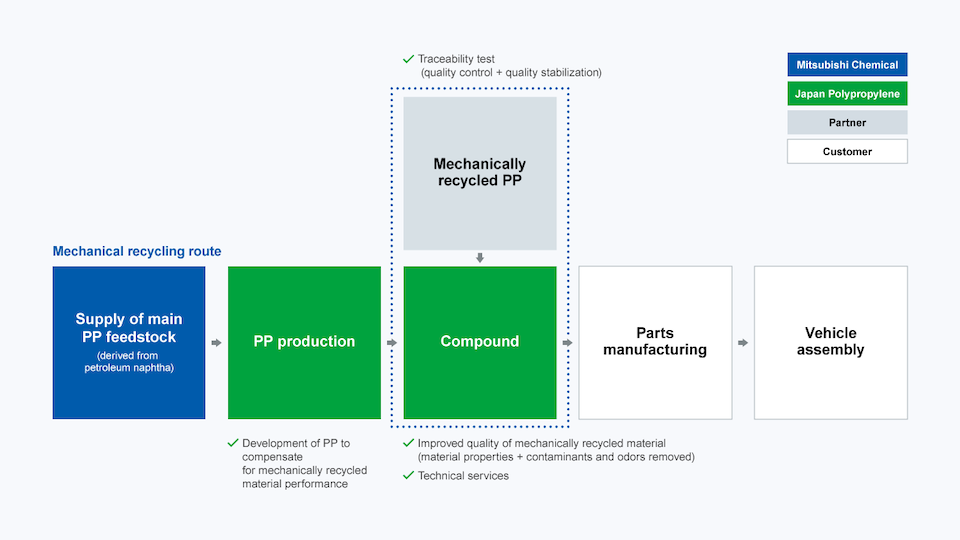
To explain the specific production flow (shown in the figure below) in more detail: using the supplied feedstock, Japan Polypropylene produces virgin PP suitable for blending with mechanically recycled PP. A plastics recycling company we partner with then blends this virgin PP with mechanically recycled PP that was made from waste plastic. After adjusting properties and removing contaminants and odors at Japan Polypropylene, we get high-quality mechanically recycled PP. The ELV regulations state that 25% of plastics used in new vehicles shall be replaced with recycled materials. We expect that our recycled PP will contribute to meeting this requirement.
NOVAORBIS™, the PP Brand to Reduce Fossil Resource Consumption
Building on the development of high-quality mechanically-recycled PP, NOVAORBIS™, a PP brand, was launched to reduce fossil resource consumption.
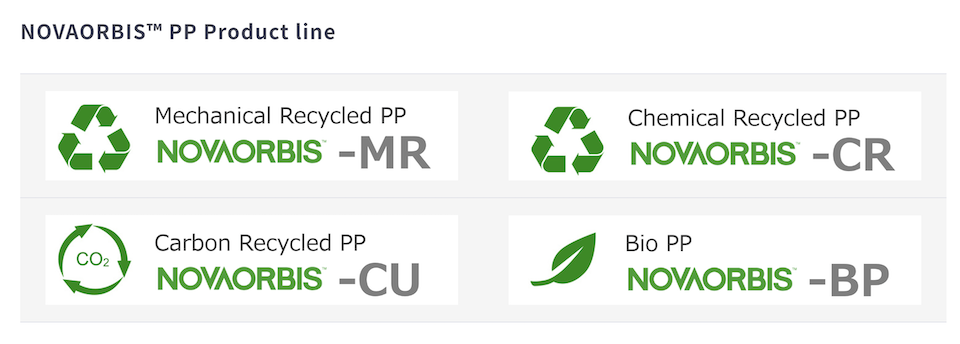
Asuka: As a member of the Mitsubishi Chemical Group, Japan Polypropylene considers the circular economy and carbon neutrality to be key business management strategies. Therefore, to launch NOVAORBIS™ as a concrete effort to reduce the consumption of fossil resources, Japan Polypropylene has worked with another group company: Japan Polyethylene. In 2025, we began selling the mechanically-recycled PP products NOVAORBIS™-MR, along with NOVAORBIS™-CR, and NOVAORBIS™-BP. For our next step, we plan to bring to market “carbon-recycled PP,” which we will discuss later.
NOVAORBIS™-MR is mainly used in the automotive sector. We’ve developed lineups for different applications, such as for bumpers or instrument panels. While conventional recycled materials are inexpensive, they come with quality issues. However, NOVAORBIS™-MR is safe and reassuring for customers because it possesses the same quality level as virgin PP.
KG Motors has already used it for interior parts in its mibot, a small mobility robot that serves as a single-seat small BEV. While KG Motors has only used NOVAORBIS™-MR for the handle inside the door trim – an interior component – I believe it represents a solid step toward social implementation of high-quality mechanically-recycled PP by meeting customer expectations to minimize use of fossil resources in vehicle manufacturing.

After the mibot press release was issued, we have already received customer inquiries. One of them said, “We didn’t know that high-quality mechanically-recycled PP has been commercialized already.” For major automakers to use the material, we need to assume a timeline of about five years, but right now we’re taking a long-term approach by proactively sharing samples.
I expect the ELV regulations to spur strong demand from the automotive sector for mechanically recycled PP. Meanwhile, Europe’s packaging sector is also experiencing heightened need for recycled materials. We intend to leverage our expertise in automotive applications to also expand horizontally into the packaging sector.
Initiatives to Enhance Recycled Material Reliability
To stabilize the quality of mechanically recycled PP, testing is underway on a traceability system that can follow the history of recycled feedstock.
Aratake: In Europe, there are discussions about introducing a Digital Product Passport (DPP). This exemplifies the intent to disclose product lifecycle information as digital data. Going forward, I believe it will be important to have mechanisms for proving traceability, such as whether the recycled feedstock for mechanically recycled PP was collected from consumers or came from scrap produced in manufacturing processes.
Nobuhito Aratake/Sustainability & Government Affairs Division, Sustainability & Solutions Department, Mitsubishi Chemical Corporation
That is why we are conducting a test to demonstrate a traceability system designed to stabilize the quality of mechanically recycled PP. This project involves recycling company Chubu Nihon Plastics, Japan Polypropylene, and Mitsubishi Chemical. We’re using a cloud-based platform to centrally manage data, from raw material receipt through shipment.
Specifically, the information we input includes: the origin of the waste plastics (such as home appliances and packaging); storage conditions for the waste plastics we use; processing conditions such as melting temperature and duration; and shipping information. By entering the data on the entire process, from receipt to shipment, the system allows us to manage and trace the feedstock. Visualizing the mechanically recycled PP production process leads to more accurate quality control. It also reassures customers and instills trust in them, because the system clearly shows them information on the origin and quality of the recycled materials used to make the products they buy. Meanwhile, selecting which items should be recorded is difficult, so we are meticulously determining the right balance between our lists of necessary data and the work that goes into collecting it.
In the future, we also want to trace the waste plastics used in NOVAORBIS™-MR, which will enhance brand value. The ultimate goal is disclosure to the general consumers. Just like scanning a QR code to see who produced an agricultural product, our goal is to ensure transparency and reliability for mechanically recycled PP.
We’re also considering how to respond to the DPP that Europe will introduce. While maintaining compatibility with international standards, we plan to export data from our traceability system and link it to the DPP. And in Japan, we’re now considering how to respond to the developments concerning public data-linkage platforms, such as the Ministry of Economy, Trade and Industry’s Ouranos Ecosystem (an effort to bring data and system collaboration across companies, industries, and national borders) and the Chemical and Circular Management Platform (CMP)
Four Futures Created by NOVAORBIS™
Komiya: Japan Polypropylene takes the lead with NOVAORBIS™-MR, while Mitsubishi Chemical serves only as a conventional supplier of virgin feedstock. However, for chemical-recycled PP product NOVAORBIS™-CR, bio-based PP product NOVAORBIS™-BP, and carbon-recycled PP product NOVAORBIS™-CU, Mitsubishi Chemical and Japan Polypropylene’s collaboration extends beyond a supplier and user relationship, as we are also working together on the business model, including marketing and sales methods.
Mitsubishi Chemical’s recycling business breaks down waste plastics with heat and pressure to return them to a state near that of crude oil. This produces naphtha that is equivalent to a new material. From that naphtha, we produce propylene, the feedstock for PP, and provide this feedstock to Japan Polypropylene. Let me provide an easy-to-understand analogy involving chocolate. If you melt a chocolate bar and solidify it again, that’s mechanical recycling. If you break it down to its raw ingredients like sugar and cocoa mass, that’s chemical recycling. Because chemical recycling returns materials to the feedstock level, followed by several purification steps, you can get quality equivalent to virgin material. It also lets you utilize waste plastics that are difficult to handle via mechanical recycling. In July 2025, we finished building a chemical recycling plant in Ibaraki that can process 20,000 tons a year, the largest capacity in Japan as of 2025. With the plant’s propylene as feedstock, we released NOVAORBIS™-CR in fiscal year 2025.
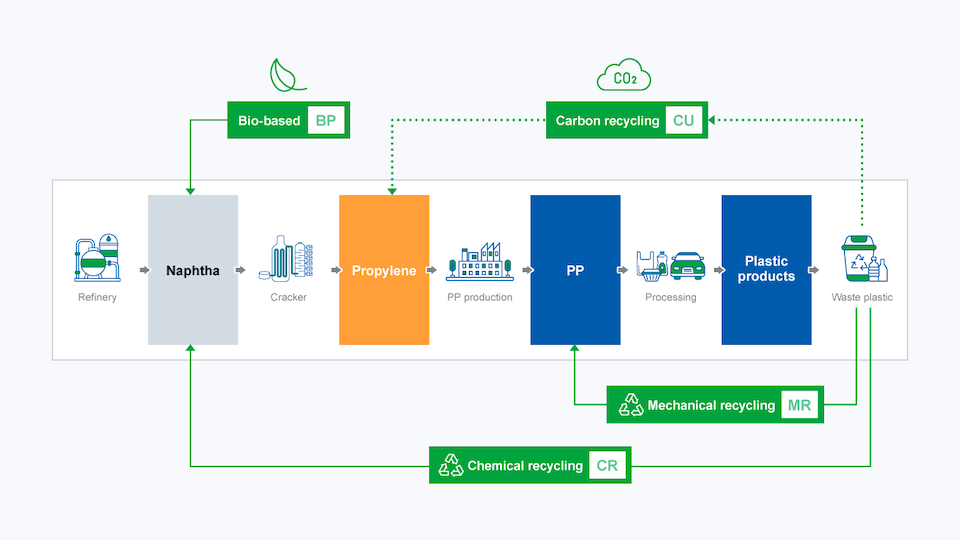
Next, bio-based PP is PP that is derived from plants and other biomass. It involves the production of plastics from biomass that have absorbed CO2 from the atmosphere. Japan Polypropylene launched it as NOVAORBIS™-BP in fiscal year 2025. Mitsubishi Chemical is working with Japan Polypropylene to expand the use of biomass feedstocks.
In terms of carbon utilization, we are considering a business that produces PP from carbon dioxide. At a project in the planning stage in Abu Dhabi in the UAE, we are using electricity from renewable energy to produce hydrogen from water, and then synthesize methanol from the hydrogen and CO2. This methanol would be converted into propylene that would serve as feedstock for manufacturing PP. Currently, waste plastics that are difficult to process through either mechanical recycling or chemical recycling end up being incinerated, but in the future we believe we will be able to capture the CO2 generated during incineration and recycle it as carbon, thereby enabling resource circulation.
Many people we talk to at exhibitions are surprised and ask if this is actually achievable technical feasibility on demo plant scale. Right now, we’re exploring business in Abu Dhabi. In Japan we will carry out a small-scale test with JFE Steel and Mitsubishi Gas Chemical at the Mizushima Industrial Complex in Okayama, where a project is underway to manufacture chemical products by effectively utilizing CO2 in by-product gases that are generated during steel production. We aim to commercialize this type of carbon recycling and sell it as NOVAORBIS™-CU beginning in or around 2030.
Sakurako Komiya/Strategy & Planning Division, CN & CE Strategy Department, Basic Materials & Polymers Business Group, Mitsubishi Chemical Corporation
Asuka: We take pride in the Mitsubishi Chemical Group, perhaps being the only company in the world putting out a lineup of four types of PP for reducing fossil resource consumption. Automotive sector demand for high-quality mechanically recycled PP is steadily increasing, yet many companies find it difficult to secure sufficient volume and quality. Mechanical recycling alone may not be good enough for some high-spec parts, so a selection of chemical recycling (CR) options will help meet customers’ longer-term expectations.
Customers are watching regulatory trends as they explore how to combine and use different recycled and bio-based materials. We believe it is important to build an organization that enables us to offer optimal solutions, no matter how the external environment changes.
Collaboration and Framework-Building Toward Implementing Recycled PP
Aratake: At present, we don’t have traceability to connect the entire supply chain. In the future, our goal is to build a framework enabling end-to-end linkage of data on environmental value, from upstream to downstream. By presenting data, we can prove that NOVAORBIS™ can contribute to the environment, help our company in confidently delivering to the market products that reduce fossil resource consumption, and promote circularity throughout society.
Komiya: Our unit’s mission is to supply materials made from sustainable feedstock. Instead of petroleum-derived naphtha, we will make products with feedstock derived from waste plastic, biomass, and carbon dioxide. My role is to launch and advance projects toward making that happen. It is within reach technologically, but what’s important is to build a framework that is economically viable. We need to thoroughly consider what customers and consumers want, as well as what kind of organization and scheme to use in projects that will enable sales. Sales are what sustain a business. Environmental consideration is a prerequisite, but unless the business is also economically sustainable, a company cannot keep it going. While collaborating with group companies, partner companies, and customers, we will further the shift to sustainable feedstocks – and the creation of a recycling-oriented society – in a way that is also sustainable for business.
Asuka: We want to communicate closely with our customers and partner companies within an integrated supply chain to steadily build the emerging market for recycled PP. Toward that end, collaboration with Mitsubishi Chemical on feedstocks is especially important. Connections are a key aspect of Mitsubishi Chemical Group’s management policy, KAITEKI Vision35. That’s because creating a recycling-oriented society is not something that one company can achieve on its own. First, we will strengthen collaboration within the MCC Group. Then, through partnerships with recycling companies, co-creation with customers, and connections with a wide range of players, we want to support the future of mobility through NOVAORBIS™.
Japan Polypropylene Corporation
Company Profile | Japan Polypropylene Corporation
- Share


