
Toward solving challenges in the food industry.
Options that support the future of food
-“Sugar Esters - food emulsifiers”
1/30/26
/ TEXT BY MCG
*The information, positions and affiliations mentioned in this interview reflect the status at the time of the interview.
Mitsubishi Chemical is engaged in “food quality preservation” as one of its business focus areas. Maintaining freshness for longer supports food distribution and processing. Playing a role in this challenge is the food emulsifier, RYOTO™ Sugar Ester. Here we speak to three members in this field, to elucidate the value this product contributes to the complex challenges of reducing food loss, contributing to health promotion and reducing environmental impact.
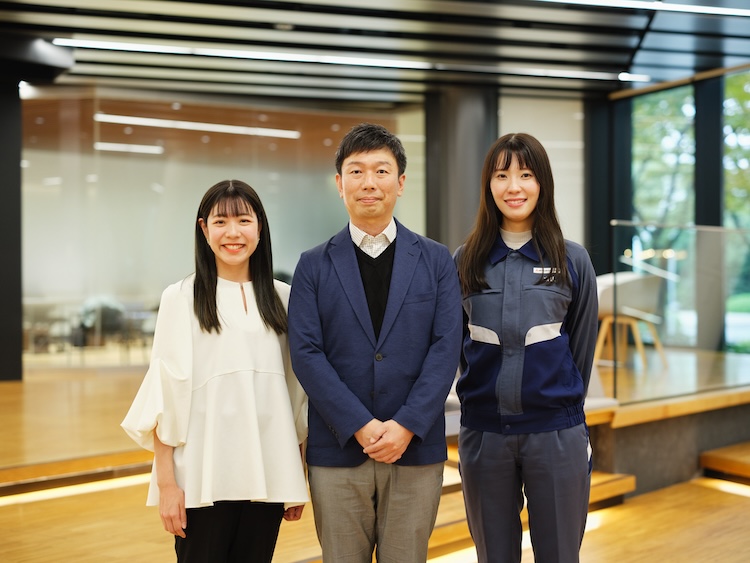
-
From left:
Mayu YamadaSales Team 1, Food Business Group, Food & Healthcare Department Life Solutions Division, Advanced Solutions Business Group
Hisayoshi ToriiHealthcare Business Group Manager, Food & Healthcare Department Life Solutions Division, Advanced Solutions Business Group
Sachiko KitayamaFood & Healthcare Group, Wellness Technology Department, Technology Strategy Advanced Solutions Business Group
What we deliver are food solutions
RYOTO™ Sugar Ester is an emulsifier primarily consisting of sucrose and fatty acids derived from vegetable oils. It is capable of uniformly blending oil and water which helps maintain quality during food processing, distribution and storage. It is used in a wide range of sectors including beverages (such as canned coffee), dairy products (such as whipped cream), and confectionery (such as cakes and chocolate).
Torii:
RYOTO™ Sugar Ester is one emulsifier product offered by our company and is a product with a long history. Currently our primary markets include Japan, China and Southeast Asia, while we are also targeting the U.S. as a future focus region. Japan has a very high standard of processed foods, and sugar esters are partially responsible for this standard. We believe that our mission is to spread the value of sugar esters worldwide by understanding specific regional needs.
We have developed “solution-based sales” based on gaining a deep in-house understanding of the characteristics of each product and then communicating those characteristics and advantages to customers. That business has steadily expanded, and we have reached the stage of making a leap forward through initiatives such as overseas expansion.

Hisayoshi Torii
Healthcare Business Group Manager, Food & Healthcare Department Life Solutions Division, Advanced Solutions Business Group
Responsible for pharmaceuticals, cosmetics, supplements, industrial and agricultural/livestock sectors.
Yamada: From a sales perspective, we deepen our understanding of each product’s characteristics by visiting research facilities and maintaining close, day-to-day communication with our R&D teams. We then leverage this knowledge to exchange information with customers and make proposals. As a result of repeating this style of engagement, since I first started in sales there has been an increase in customers coming to discuss their concerns, and in opportunities for them to seek better solutions. As a salesperson it is very motivating to feel that customers perceive Mitsubishi Chemical as a potential solution provider.

Mayu Yamada
Sales Team 1, Food Business Group, Food & Healthcare Department Life Solutions Division, Advanced Solutions Business Group
Responsible for sales. Mainly offering RYOTO™ Sugar Ester to confectionery manufacturers.
Kitayama: In addition to the sales staff coming directly to the research laboratory and sharing information, they also share weekly sales reports so that customer viewpoints and issues will definitely reach frontline developers. As a result of such engagement, we have frequent discussions along the lines of, “Perhaps we could use this type of thing for this issue?”
Sugar ester production achieved by virtue of being a diversified chemical manufacturer
The emulsifier business has continued to grow under “solution-based sales”. The production of sugar esters is the source and core of that business and can only be achieved by an extremely limited number of manufacturers globally. This is where Mitsubishi Chemical’s proprietary technologies cultivated over many years as a diversified chemical manufacturer, came to the fore.
Torii: Sugar esters are broadly classified as food additives and are labelled as “emulsifiers” on processed food packaging. Issues surrounding oil-derived emulsifiers include a significant impact on the flavor of foods to which they are added, and a narrow range of functionality. On the other hand, sugar esters are compounds made by combining sucrose, which is the main ingredient of sugar, with fatty acids derived from plants. The flavor is not oily, and there is very little impact on taste even as an additive in processed food. Furthermore, they have the advantages of a broad range of functionality enabling development of a variety of sugar esters depending on the application.

Kitayama: The breadth of its functionality compared with other emulsifiers comes from differences in its hydrophilic group. An emulsifier is a food additive that stabilizes mixtures of water and oil. It has a matchstick shape, with the head of the matchstick being the hydrophilic group (the part that mixes well with water), and the stem of the matchstick being the lipophilic group (the part that mixes well with oil). Combining these two groups produces a property that facilitates the mixing of oil and water.
Giving it highly hydrophilic properties makes it usable in beverage applications, while highly lipophilic properties make it usable in products like chocolate which have a high fat content. Furthermore, changing the formulation will achieve different effects even if used in the same product. For example, adjusting the composition of sugar esters used in bread can give a moist finish or a soft, fluffy finish. The interesting thing is how using them differently and in combination this way greatly expands potential applications.

Sachiko Kitayama
Food & Healthcare Group, Wellness Technology Department, Technology Strategy Advanced Solutions Business Group
Responsible for sugar ester research and development
Torii: Mitsubishi Chemical‘s strength lies in its various manufacturing technologies cultivated as a diversified chemical manufacturer. Without these technologies the production of sugar esters is difficult, the number of manufacturers capable of producing them worldwide is limited to a few, and Mitsubishi Chemical has secured the top share.
On the other hand, demand for sugar esters is increasing. Particularly in emerging countries, the middle class is expanding along with economic growth, and consumption of luxury beverages and chocolates is on the rise. In the U.S., partially because of insufficient proposals and only setting usage standards for limited applications, sugar esters were not often used as emulsifiers. However, with the establishment of a U.S. sales structure and pursuit of legal compliance for expanded applications, we anticipate future increase in demand. To meet these demands, in March 2024, we expanded our manufacturing facility at the Mitsubishi Chemical Kyushu Plant. Also, in March 2026, we plan to add a new line which will increase the annual manufacturing volume by more than 3,000 metric tons.
Sugar esters contributing to solving food issues
Mitsubishi Chemical’s mission is to solve major social issues by reducing food loss, contributing to health promotion, and reducing environmental impact. Sugar esters provide multifaceted solutions taking account of everything from B2B to consumer satisfaction and end benefits, contributing to the achievement of KAITEKI, the well-being of people and the planet.
Torii: In the development of emulsifiers, we are placing particular emphasis on reduction of food loss. Food loss within Japan is estimated at approximately 4.64 million metric tons annually. Of this, “business sources” and “household sources” account for about 50% each. Given that we are engaged in B2B commerce, we believe that we can contribute to reduction of food loss from business sources, while also setting our sights on contributing to health promotion and reducing environmental impact.
Yamada: Customers are also increasingly seeking solutions that help address social challenges. We explain that the fact that improving operational efficiency at the production sites of our customers and extending food storage life using emulsifiers can contribute to reduction of food loss from business sources.
Kitayama: From a development perspective,, we are proactively engaging in technologies that link to food loss reduction. In addition, we are promoting the development of technologies that lead to the promotion of end user health.
Yamada: I work with confectionery manufacturers and in the area of food loss reduction the defoaming effect of sugar esters is useful. For example, in the candy manufacturing process, foam appears during reduction. Leaving the foam changes the texture and products containing foam may be discarded. This is where we introduced sugar esters, formulated to enhance the defoaming effects. The alignment of emulsifiers at the interface between the candy solution and the air reduces surface tension and settles the foam. This reduces waste caused by foam and leads to a reduction in food loss.
Generally, we add oil when we want to suppress foam but adding oil changes the contents which also changes the candy recipe and flavor. Sugar esters however have no impact on the flavor or the recipe. That is a factor appreciated by our customers. Apart from candy, foam also occurs when reducing jams and the recently popular gummies, as well as when bottling beverages and during the production of fermented foods. We are proposing better solutions tailored to customers’ products.

Kitayama: In terms of contributing to health promotion, we are currently developing a formulation for extending the shelf life of fermented milk”. Fermented dairy products such as yogurt are distributed with lactic acid bacteria in a live state. However, these bacteria metabolize sugar and produce lactic acid, so fermentation progresses over time. This in turn leads to problems such as over-fermentation resulting in greater acidity and lactic acid bacteria dying, and inevitably shortens shelf life.
Currently, the shelf life of yogurt in Japan is generally about three weeks. In particular, special lactic acid bacteria with health benefits are delicate and prone to dying. This tends not to be a problem in Japan due to its well-developed distribution network, but maintaining quality is difficult in vast countries like China and regions like Southeast Asia where much of transportation is via sea or air. Solving this issue and extending shelf life would enable delivery of yogurt to more people, contributing to health and reducing food loss.
We then focused on the fact that sugar esters, which are emulsifiers, have a secondary “bacteriostatic action”. Adding sugar esters to yogurt suppresses over-fermentation and maintains the lactic acid bacteria count without killing them. We are developing a formulation for extending the shelf life of fermented milk which has such sugar esters as its active ingredient.

However, given the difficulty of introducing sugar esters in powdered form to a production process, we are also working on the development of a “high-concentration liquid sugar ester” formulation. While it is difficult to increase concentration, if it can be put into practical use, it could be applied not just to yogurt but to other products where implementation was previously problematic.
Torii: In relation to reducing environmental impact, as an alternative to per- and poly-fluoroalkyl substances (PFAS) which is widely used in food packaging paper, we are developing a water- and oil-resistant coating solution using sugar esters. There are concerns that PFAS used in food packaging paper are harmful to human health and cause environmental pollution so that regulations are being accelerated, mainly in Europe and the U.S. In light of this worldwide trend to phase out PFAS, we embarked on research and development of PFAS alternatives.
While sugar esters mix well with both water and oil, depending on the formulation, they can be made into substances that do not mix with either. We have leveraged this characteristic to drive development of an “aqueous sugar ester dispersant” which is an emulsion coating agent primarily composed of water-and oil-resistant sugar esters. Applying this dispersant to food packaging paper produces a water- and oil-resistant coating.
We do not plan to develop this “aqueous sugar ester dispersant” solely in our division but in collaboration with Mitsubishi Chemical group companies that know the food container and packaging market and have sales channels for coating materials. Two major fluorine manufacturers have already stated that they will cease production by the end of 2026. In that sense, we believe that the next one to two years will be crucial.

Sugar esters forging the future
Applications for sugar esters are expanding in response to changing times. Underpinned by the technical expertise of Mitsubishi Chemical, and through improved convenience of manufacturing sites and accelerated overseas expansion, we will achieve KAITEKI around the world in every sense, including reductions of both food loss and environmental impact.
Yamada: The current worldwide shortage of cacao has resulted in an increase in products known as compound chocolate, which use vegetable oils such as palm oil and sunflower oil instead of cocoa butter. Even if replacing cocoa butter with vegetable oil causes quality and production process issues, these can potentially be solved through skillful use of sugar esters. As times continue to change, certain raw materials will inevitably become more expensive and harder to obtain. We will continue to offer optimal solutions adapted to the challenges our customers face in those times.
Torii: We are also undertaking research and development, not only in packaging paper, but in maintaining freshness of finished products themselves, such as fruit and vegetables, by coating them. The term “food additive” tends to make people cautious but the primary ingredients of sugar esters are sucrose and fatty acids derived from vegetable oils, and evaluation by public agencies in multiple countries including the U.S., Europe and Japan has determined that they are not a safety issue.
By combining the various manufacturing technologies that Mitsubishi Chemical has cultivated over the years, we are confident in our ability to ensure the safety of products intended for human consumption, while also delivering essential functionalities required in processed foods.
Kitayama: Through the high-concentration liquid sugar ester mentioned earlier, we aim to make sugar esters easily usable even for customers who do not have equipment for handling powdered materials. This will allow us to expand our reach to customers who have not previously been able to adopt sugar esters. With ongoing research, and by responding to customer needs one at a time, we wish to provide all food manufacturers with easy-to-use sugar esters, and in doing so enable consumers to obtain products that are tastier and lead to better health. In addition, we will continue to reduce both food loss and environmental impact.
Yamada: The goal for the overall business is to accelerate its expansion overseas. Naturally this includes reaching overseas confectionery manufacturers, but we can also assist domestic confectionery manufacturers with their overseas exports and local production. For example, our extensive range of sugar ester products allows us to offer sugar esters with diverse characteristics while meeting the standards and usage criteria established in various countries. Some brands have obtained Islamic Halal certification and Jewish Kosher certification. In the future, we plan to further support overseas expansion by domestic manufacturers, while also expanding the use of emulsifiers themselves to overseas users.
Torii:
Sugar esters have a history of over 50 years and have provided a variety of solutions to many processed food manufacturers in Japan. We would like to leverage this accumulated expertise for overseas expansion and spread it globally. Mitsubishi Chemical not only handles sugar esters but also a diverse range of materials including lactic acid bacteria and enzymes. In the food sector our focus is on solutions for processed foods, while in the healthcare sector we provide solutions to a wide range of industries including pharmaceuticals, supplements, and agricultural and livestock products.
Our strength lies in the ability to leverage these diverse options to make optimal proposals that meet our customers’ challenges. We are aiming to achieve KAITEKI in every sense of the term, not limited to food loss reduction or the provision of great flavors and safety, but also leading to reduction of environmental impact.

Click here for the Food & Healthcare Division website
Food & Healthcare Department Product & Technology Information Site
- Share


