
Cross-functional Solutions Supporting Mobility Transformation
and Environmental Regulations
08/05/26
/ TEXT BY MCG
*The information, in this interview reflect the status at the time of the interview.
As a comprehensive chemical company, the Mitsubishi Chemical Group leverages a wide range of materials to provide comprehensive mobility solutions that address evolving vehicle requirements driven by electrification and environmental regulations.
Total Solutions that Support the Evolution of Mobility
Advances in electrification and autonomous driving are bringing about significant changes in vehicle structures and interior spaces. In addition, stricter environmental regulations, mainly in Europe, mean that material selection is also at a critical turning point. Mitsubishi Chemical Group’s KAITEKI Vision 35 (KV35) sets out a vision for the mobility business area: supporting the evolution of mobility through materials. By leveraging the Group’s diverse materials and technologies, we provide comprehensive solutions to customers for diverse issues including weight reduction through replacing metal with plastics, cost reduction, and recyclability.
In this article, we feature key solutions supporting next-generation mobility, selected from more than 50 materials and technologies introduced at the Automotive Engineering Exposition 2026.
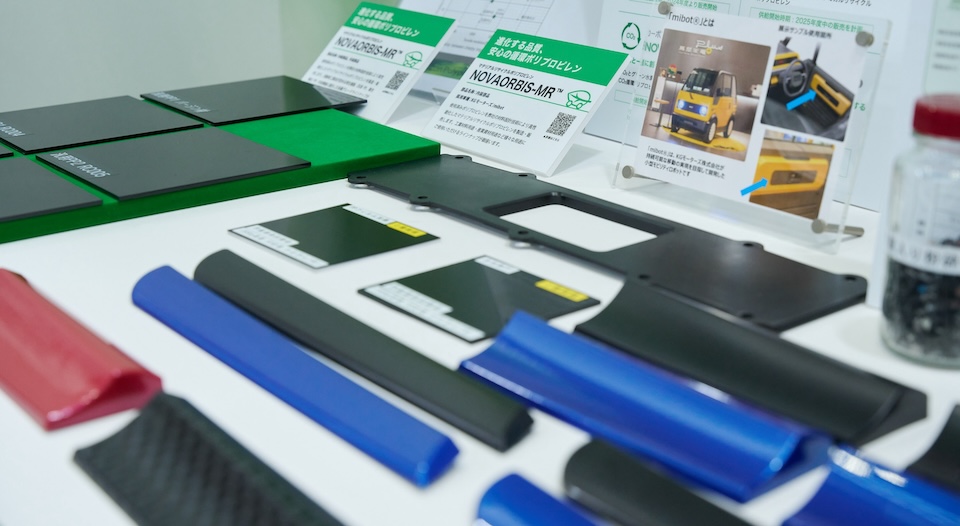
NOVAORBIS™-MR: Mechanically Recycled Polypropylene (PP) Designed to support automakers in responding to the European ELV Regulation
Background and issues In the automotive industry, increasing attention is being paid to requirements related to reusability, recoverability, and the use of recycled content in vehicle design and production. This comes from the End-of-Life Vehicles (ELV) Regulation adopted by the European Parliament in June 2026. By 2032, the plastic contained in each car shall contain a minimum of 15% of plastic recycled by weight from post-consumer plastic waste.
Points noted by team members NOVAORBIS™-MR, offered by Japan Polypropylene Corporation, is a mechanically recycled PP (polypropylene) material derived from post-consumer waste. It achieves physical properties comparable to those of virgin materials and meets the high standards required for automotive use. We are offering a range of options depending on the application, including use in bumpers and instrument panels.
Feedback from Exposition visitors highlighted that NOVAORBIS™-MR, a mechanically recycled material that meets industry standards, really resonated with them.
Click here for the link to the NOVAORBIS™-MR article.
https://www.mcgc.com/english/kaiteki_solution_center/oursolution/28.html
Polypropylene (PP) for Decorative Films Designed with the EU ELV Regulation in Mind
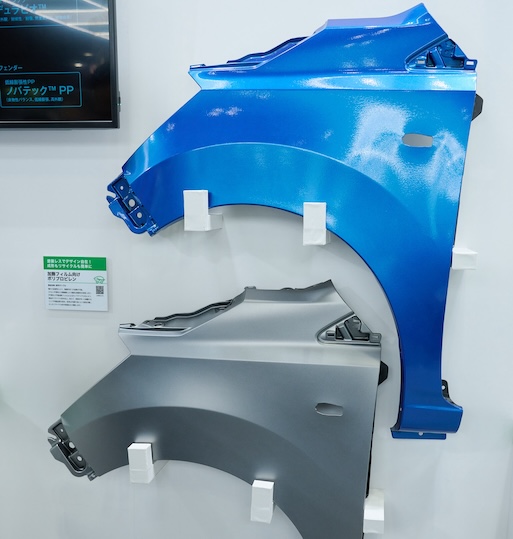
Background and issues To address requirements under the EU ELV Regulation, reducing painting processes and promoting mono-materialization through the use of standardized materials have become important topics.
Points noted by team members Decorative PP film is a product that produces a paint-like, high-design appearance by adhering to PP components widely used in automotive parts. In vehicles, it is intended for use in interior components as well as exterior components such as bumpers and fenders. By using polypropylene (PP) for both the substrate and the decorative film, the materials may be collected, shredded, and recycled together, potentially allowing them to be processed through the same recycling stream. In addition, because decorative PP film adheres to components via thermal bonding, it enables decoration without using adhesives, which also helps reduce painting processes.
While conventional decorative films mainly used materials like acrylic and ABS resins, the use of WEIMAX™, a high melt-strength polypropylene (HMS-PP) using an original metallocene catalyst technology developed by Japan Polypropylene Corporation, enables excellent thermo-formability even with PP.
Its two key features are as follows.
(1) It enables decorative molding for large parts and complex shapes.
(2) Beyond mere coloring, it expands design freedom through film-specific decorative effects, such as printing and embossing.
In addition to praise from Exposition visitors for its “technical excellence,” there were also numerous questions regarding potential adoption.
Lightweight, Flame-retardant Materials Supporting EV Evolution
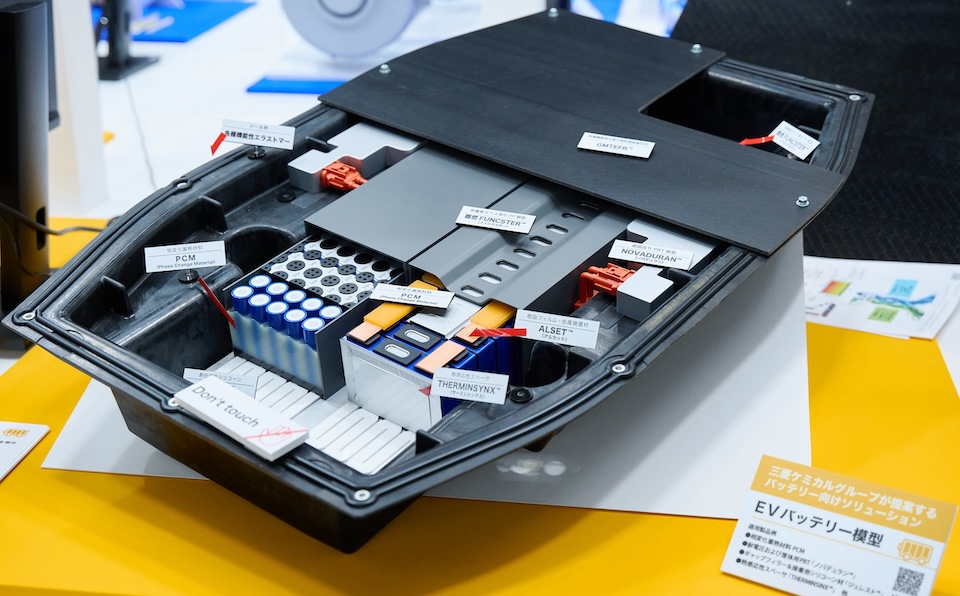
Background and issues With the widespread adoption of electric vehicles (EVs), the importance of vehicle weight reduction is increasing as it directly leads to extended driving range. As a result, there is a growing shift toward replacing some metal parts with plastic materials. On the other hand, high safety standards are also required, particularly for components around the battery. Therefore, balancing weight reduction and safety has become a key development theme in the automotive industry.
Points noted by team members: Flame-retardant FUNCSTER™ FUNCSTER™ is a high-performance long glass fiber reinforced thermoplastic resin developed using Japan Polypropylene Corporation’s proprietary technology. By combining it with flame-retardant formulation technology, a product has been developed that provides a high level of flame retardancy while maintaining mechanical strength.
Its three key features are as follows.
(1) Achieves high strength and flame retardancy, contributing to enhanced safety.
(2) May support EV energy efficiency improvements through weight reduction when used as a replacement for certain metal components.
(3) Allows for flexible molding to match the battery shape.
The primary intended applications include EV battery module enclosures.
Points noted by team members: GMTeFR™ (Flame-retardant Glass Mat Reinforced Thermoplastic GMT) GMTeFR™ from Mitsubishi Chemical Advanced Materials is a material developed to enhance safety in the event of thermal runaway of an EV battery. It is being adopted or considered for battery module covers and battery enclosures that house the whole battery assembly including battery modules.
Its three key features are as follows.
(1) Enables weight reduction through metal replacement while providing flame retardancy.
(2) Provides better thermal insulation than metal and, by improving battery thermal management efficiency, is expected to support improvements in fast-charging capabilities and battery life.
(3) Has the potential to enable closed-loop recycling through the reprocessing of end-of-life battery cases while maintaining a high level of performance after reprocessing.*1
*1Verification is currently underway through laboratory testing.
This technology has been achieved through the combination of technologies related to fiber, plastics and batteries possessed by the Mitsubishi Chemical Group and is being proposed as a solution that realizes a balance of strength, reduced weight and processability, while also considering future mechanical recycling.
Exposition visitors also focused on the fact that the design considers future mechanical recyclability while maintaining flame retardancy.
Click here for the link to the GMTeFR™ (Flame-retardant Glass Mat Reinforced Thermoplastic GMT) article.
https://www.mcgc.com/english/kaiteki_solution_center/oursolution/29.html
TEFABLOC™ TPS QE Series Supporting Comfort in the Next-generation Mobility
Background and issues While achieving comfortable interior spaces is also an important topic for current vehicles, the value of the time spent inside the cabin is expected to increase with advances in autonomous driving technology. As opportunities to work or enjoy entertainment in vehicles increase, and as demand grows for living room-like comfort in future mobility, interior materials will also be required to offer a comfortable feel, quietness and also recyclability.
Points noted by team members The TEFABLOC ™ TPS QE Series has been adopted for interior vehicle parts including armrests, console boxes, instrument panel pads and grab handles.
Its two key features are as follows.
(1) Offering excellent wear, scratch and oil resistance while providing smooth and silky textures.
(2) The ability to make parts by injection molding is expected to reduce costs through process streamlining.
Reso-Core™, an acoustic metamaterial sound-insulation and vibration-damping sheet, is also gaining attention in response to the demand for quieter operation. The key feature is its outstanding soundproofing effect within a specific frequency band achieved by multiple local resonators on the sheet.
Linking Materials and Technology for the Evolution of Mobility
Electrification and increasingly stringent environmental regulations are driving the need for new forms of mobility. The Mitsubishi Chemical Group is supporting the evolution of mobility through advances in materials and its ability to “connect” them.
Related information
Click here for details and enquiries relating to automotive solutions.
https://automotive.mcgc.com/
Comments from Exposition staff
- While the Exposition is a platform for showcasing products, it also serves as a valuable opportunity to connect with both existing customers and potential new customers.
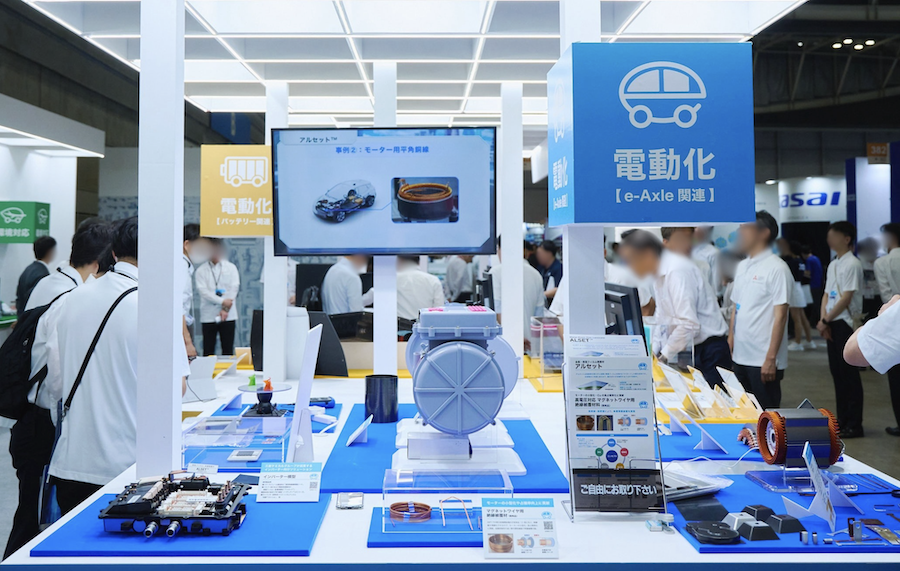
- At this year’s Automotive Engineering Exposition 2026, we structured the exhibition to showcase “integrated solutions” that combine materials and technologies undertaken by our group companies and various business divisions. We exhibited in a way that helps visitors understand how the materials and technologies are used in different parts of a vehicle. Visitors responded positively, noting that the exhibits were clearly organized by component and application and were easy to understand.
- The Mitsubishi Chemical Group is connecting multiple businesses and materials to propose comprehensive solutions. We will continue to contribute to automotive and component manufacturers from a variety of perspectives, including weight reduction through the use of plastics and metal replacements, cost reduction and recyclability.
- Share


Index
- Total Solutions that Support the Evolution of Mobility
- NOVAORBIS™-MR: Mechanically Recycled Polypropylene (PP) Designed to support automakers in responding to the European ELV Regulation
- Polypropylene (PP) for Decorative Films Designed with the EU ELV Regulation in Mind
- Lightweight, Flame-retardant Materials Supporting EV Evolution
- TEFABLOC™ TPS QE Series Supporting Comfort in the Next-generation Mobility
- Linking Materials and Technology for the Evolution of Mobility
- Share


